Key Takeaways
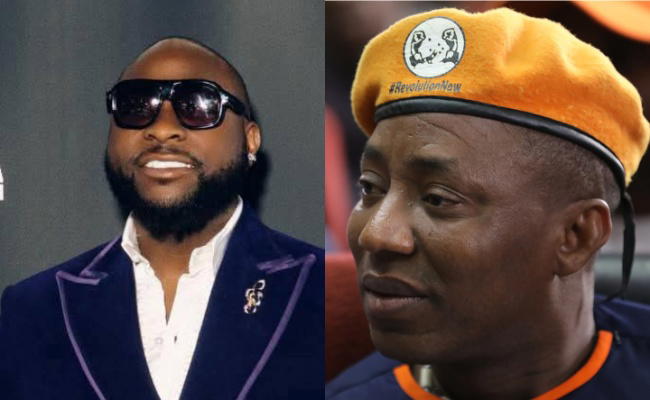
- Award-winning Nigerian singer Davido and human rights activist Omoyele Sowore engaged in a public social media spat.
- The dispute originated from Sowore's critical remarks about Osun State Governor Ademola Adeleke, Davido's uncle.
- Sowore labeled Governor Adeleke 'brainless' and criticized Osogbo's infrastructure, likening it to a 'war zone.'
- Davido responded by calling Sowore an 'Arindin,' a Yoruba term implying foolishness.
- Sowore escalated the exchange, accusing the Adeleke family of treating Osun State as a 'private estate' and criticizing the governor's political record.
A significant social media storm has brewed between global music sensation Davido and prominent human rights activist Omoyele Sowore, following Sowore's pointed criticisms of Osun State Governor Ademola Adeleke, who is Davido's uncle. The public disagreement has drawn widespread attention, highlighting the often-turbulent intersection of celebrity influence and political discourse in Nigeria.
The controversy ignited after Sowore, known for his outspoken views and investigative journalism through Sahara Reporters, made strong comments about Governor Adeleke during a recent interview. Addressing the forthcoming Osun governorship election, Sowore did not mince words, describing the governor as 'brainless' and asserting he had 'nothing upstairs.' He further lambasted the state of infrastructure in Osogbo, the Osun State capital, vividly portraying the city as a 'war zone,' a description that quickly became a flashpoint.
Davido, a figure with immense social media reach and a powerful voice among Nigerian youth, swiftly entered the fray. He shared a clip of Sowore's interview on X (formerly Twitter) and retorted by calling the activist an 'Arindin.' This Yoruba term, used to describe someone considered foolish or unintelligent, immediately escalated the personal nature of the exchange, moving beyond mere political commentary.
Sowore, a former presidential candidate and a veteran of political activism, was quick to respond to Davido's jab. He argued that the 'Arindin' label was far more fitting for Governor Adeleke. The activist then broadened his attack, launching into a scathing critique of the governor's political record, particularly his decision to support President Bola Tinubu during the contentious 2023 presidential election. This move, Sowore implied, demonstrated a lack of independent political thought or a calculated loyalty for personal gain.
In a direct address to Davido, Sowore wrote, 'The real arindin is your uncle, @AAdeleke_01, who had to go back and obtain the equivalent of a GED after he had already served as a Nigerian Senator.' This comment brought Governor Adeleke's educational background into the public debate, an issue that has previously surfaced in Nigerian political circles. Sowore continued his tirade, stating, 'The real arindin is your uncle who chose @officialABAT as his presidential candidate, apparently hoping that imbecilic political loyalty would allow your family to continue treating Osun state as a private estate to finance your extravagant lifestyle.'
He concluded his fiery response with a broader condemnation of the Adeleke family, accusing them of being 'oppressive, corrupt, incompetent, and entitled spoilt brats, feeding off the pain, suffering, and sorrow of Nigerians. But the tables will turn. The Nigerian people will not endure this forever.' These accusations of treating a state as a 'private estate' are particularly grave in the context of Nigerian politics, where issues of corruption and governance are constant public concerns. The exchange underscores the volatile nature of political discourse in Nigeria, especially when amplified by the reach of influential public figures.
Why This Matters
This high-profile social media confrontation between a global music icon and a seasoned activist highlights the increasing role of celebrities in shaping political narratives and public opinion in Nigeria. Such exchanges not only draw attention to governance issues in states like Osun but also reflect the deep-seated frustrations and political divisions within the nation, demonstrating how personal attacks can quickly overshadow substantive policy debates.