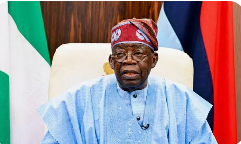
ABUJA — President Bola Ahmed Tinubu has outlined the next phase of his administration’s economic agenda, saying the government will focus on reducing the cost of living, creating productive jobs, expanding industries and supporting Nigerian businesses to achieve broad-based prosperity
Tinubu stated this in his Independence Day address to Nigerians on Thursday, saying the government had moved beyond the phase of economic reforms and was now focused on translating the gains into improved living standards for citizens
According to him, the immediate priority is to reduce the cost of producing and transporting goods consumed by Nigerians
“Our priority is to bring down the cost of living We will achieve this by lowering the cost of producing and moving the things Nigerians consume,” he said.
The President said his administration would expand mechanised irrigation and dry-season farming, improve access to seeds and fertiliser, increase agricultural mechanisation and invest in storage and transportation
He also said the government was building and completing roads, railways and ports to connect farms and factories to markets
Tinubu said reducing production and transportation costs would eventually translate into lower prices for consumers
“When a farmer produces more cheaply, when fewer crops are lost between the farm and the market, when a manufacturer spends less on electricity, when a truck reaches its destination faster, and when the business environment fosters fair competition, all those savings will ultimately find their way into the price of goods in the market,” he said
The President said prosperity would require more than cheaper goods, stressing the need for productive employment and stronger businesses
“Prosperity requires more than cheaper goods It requires productive work,” he said.
Tinubu said his administration would place jobs, enterprise and industrial growth at the centre of its policies, particularly as millions of young Nigerians enter the workforce each year
He said the government would use the country’s gas resources to power new industries, support businesses seeking to revive factories and expand digital connectivity to communities that had been left behind
He also pledged investment in skills required by employers and continued support for Nigerian businesses with infrastructure and financing
“I want to see more Nigerians making things I want to see more Nigerian farms feeding our cities and supplying our factories. I want to see Nigerian businesses selling Nigerian goods to the whole world. I want young Nigerians building unicorns and creating opportunities for others here at home,” Tinubu said.
On social protection, the President acknowledged that millions of Nigerians were still struggling with food, school fees, medical bills and transportation costs
He said the challenges facing many families predated his administration and reflected decades of low productivity, inadequate infrastructure, insufficient opportunities and institutional weaknesses
“We cannot erase in four years what accumulated over generations But we can change its course,” he said.
Tinubu said the government would strengthen direct support for poor households and improve the National Social Register to ensure that assistance reached those who genuinely needed it
He also highlighted the Nigerian Education Loan Fund and CREDICORP as part of measures aimed at expanding access to education and consumer credit
According to him, the government would continue working with state and local governments to strengthen primary healthcare, basic education and other essential public services
The President said these interventions were intended to support Nigerians while the economy expanded and more productive opportunities were created
“Our objective is not to manage poverty more efficiently We will defeat it,” he said.
Tinubu said achieving the government’s objectives would take time, discipline and sustained economic growth, alongside the creation of millions of productive opportunities
He said his administration’s reforms had corrected what he described as longstanding economic distortions, arguing that the next phase was to build on the foundation laid over the past three years
“The age of reform has done its work Now begins the age of prosperity,” he said.
Tinubu said Nigeria’s economy had grown by more than four per cent in 2026, while oil and non-oil sectors contributed to what he described as a period of stable growth
He also cited lower oil theft, a decline in inflation from its peak, rebuilt foreign reserves, greater stability in the foreign exchange market and more than $6 billion in non-oil export revenue in 2025 as indicators of improving economic conditions
The President said the government’s objective was to build a Nigeria where farmers could produce more at lower cost, factories could access reliable power, businesses could obtain credit and young people could find productive work
He said the ultimate goal was a country where food and transportation were affordable, education was within reach and families could look to the future with greater confidence
“Now, our purpose is simple: shared and widespread prosperity,” Tinubu said
He urged Nigerians to remain committed to building the country, saying the road ahead would still require sacrifices but insisting that the government’s direction was clear
“Nigeria has corrected its course We have passed through our own Red Sea. This is not the time to look back. Let us go forward together,” he said.
He added: “Our destination is in sight Our foundations are strong. Our direction is clear. So let us go forward. No looking back.”