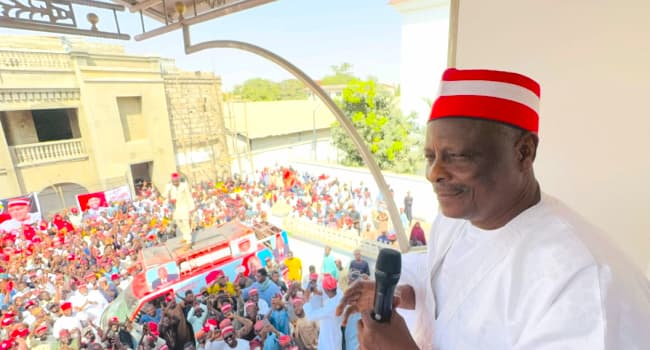
In a moment that could reshape Nigeria’s political landscape ahead of the 2027 general elections, veteran politician has officially defected to the African Democratic Congress (ADC) from the New Nigeria People’s Party (NNPP), bringing with him significant political clout and stirring new momentum in the opposition coalition.
The transition, witnessed by party stalwarts and thousands of supporters in Kano State, marks a high‑profile shift in Nigeria’s pre‑election arithmetic.
On March 30, 2026, Kwankwaso completed his formal registration with the ADC at Gidan Kwankwasiyya on Miller Road, Bompai, in Kano, receiving his membership card in front of party leaders, supporters, and members of the Kwankwasiyya Movement — a grassroots network he cultivated over decades.
Among those present were leaders of the ADC, led by former Senate President David Mark, former Minister of Interior and ADC National Secretary Rauf Aregbesola, and opposition figures including Peter Obi, Aminu Tambuwal, and Rotimi Amaechi.
Kwankwaso, a two‑term Kano State governor and former NNPP presidential candidate, called his move a “new dawn,” stressing that the political realignment is driven by Nigeria’s evolving political terrain and the need for more effective opposition collaboration.
“As a committed and bona fide member of the party, this was not an easy decision to make. However, considering the current trajectory of the nation’s political landscape, which calls for strategic realignment, I have found it necessary to identify with another political platform that offers the best opportunity to effectively change the nation,” he said in a statement he personally signed on Sunday.
Opposition Momentum Builds
Kwankwaso’s transition adds fresh energy to the ADC in the North West, which has already attracted high‑profile opposition figures who contested the 2023 presidential elections under other platforms.
His move comes as the party positions itself as a unifying alternative to the ruling All Progressives Congress (APC), seeking to consolidate support across regions and demographics in an increasingly competitive electoral environment.
In welcoming Kwankwaso, former Vice President Atiku Abubakar wrote on social media, “When men of conviction come together, power trembles,” underlining the sense of optimism among opposition ranks. Observers see this as a strategic boost for the ADC’s national profile and grassroots reach, particularly in northern Nigeria.
The ADC is actively engaging other political leaders and stakeholders, with reports noting recent outreach to influential politicians, signalling broader strategic conversations ahead of 2027.
Opposition Realignment
Kwankwaso’s defection reflects ongoing shifts in Nigeria’s political dynamics, especially in Kano, a state that produced over 3,000,000 million votes in the 2023 presidential election.
In a climate where parties and leaders continually reassess their platforms, the ADC’s rising profile comes amid debates over electoral reform, governance performance, and national unity.
Discussions about possible defections and alignments among other political heavyweights indicate fluidity in Nigeria’s multi‑party environment as the election approaches.
Moreover, recent political commentary suggests that opposition unity could play a decisive role in shaping voter sentiment, especially as the electorate weighs issues such as economic policy, security, and institutional reform.
With Kwankwaso now part of the ADC fold, analysts say the party’s broader strategy may involve leveraging his strong grassroots network while consolidating partnerships with other opposition figures. How this will translate into electoral strength will be closely watched, particularly as campaigns intensify and Nigerians prepare to cast ballots in a pivotal election year.