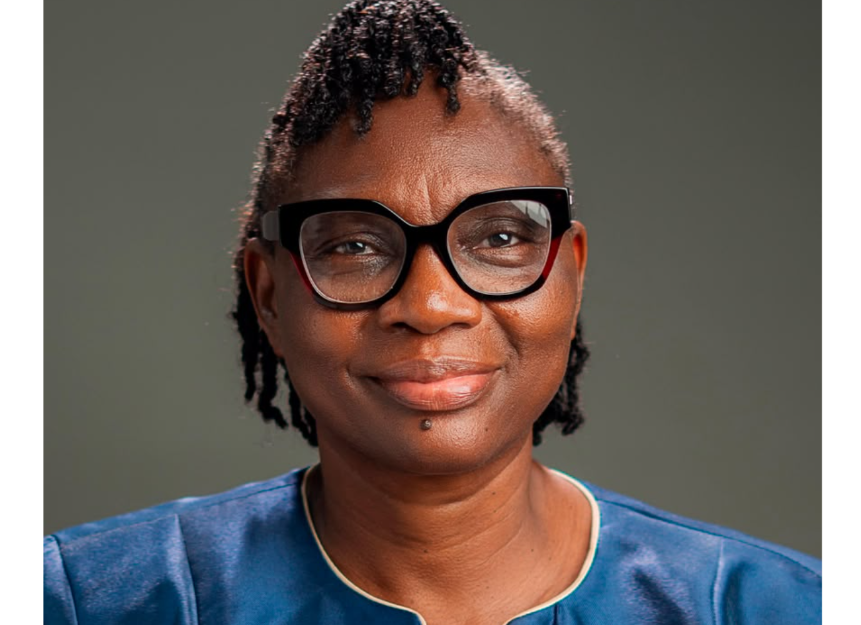
To Celebrate Inspiring buisness leaders of Excellence driving Nigerias Economic growth,Chioma kachi Ewelike sat with the professional par excellence in person of Group Managing Director ChamsHoldCo plc, Mrs Mayowa Olaniyan to discuss usiness so far
1) can you share your journey on how you became one of the leading female figure in your industry
My story did not begin in privilege I grew up in a large household where discipline mattered more than comfort, and by fourteen I was already running my own micro-business and reinvesting the proceeds. My school had only a part-time accounting teacher who came and went, so I taught myself the subject over a single school holiday. I earned six credits in WAEC, the first in my town to do so in one sitting, but failed English, which was compulsory. Rather than defend that gap, I went back to a remedial school, rebuilt from the foundation, and came back with five A’s.
That pattern, going back to fix the foundation rather than skipping ahead, has stayed with me through every role since: Audit Trainee, thirteen years at SCOA, finance leadership at Tranter International, and then Chams, where I rose from Corporate Services to Head of Internal Audit, Chief Financial Officer, Executive Director, and eventually Chams’ first female Group Managing Director None of it was accidental. It was three decades of choosing depth over shortcuts, and I carry that same discipline into how I lead the Group today.
2) How Important is diversity and inclusion to a sustainable business and economy?
Diversity and inclusion are not a courtesy, they are a business strategy A workforce and leadership team that reflect different genders, backgrounds, and experiences make sharper decisions and see risks and opportunities that a homogenous team would miss entirely. As Chams’ first female GMD, I take seriously what that appointment represents, not as a personal milestone, but as proof that capability, not gender, should determine who leads. An economy that continues to sideline capable women is an economy operating below its potential. At Chams, inclusion also means giving people ownership and responsibility early, the same way I was given room to grow long before I had a title to match it.
3) What is your Approach to talent development and building a strong team at Chams Holding?
I look for people who show initiative under limited resources, because that is the clearest predictor of how someone performs under real pressure I invest in continuous learning and give people real ownership of outcomes early, not just training modules, because responsibility is what actually develops leaders. I also expect people to be honest about their gaps rather than defend them; the fastest way to grow a team is to go back to the foundation wherever there is a weakness and rebuild it properly, rather than paper over it. Succession planning runs through this too. Across the Group’s four subsidiaries, I want capable leaders in place at every level, not dependent on any single person, including me.
4) What makes Chams Holding stand out in a crowded market?
Chams has been building Nigeria’s digital ecosystem for over four decades, longer than most fintech and identity-management players in this market have existed We are not a single-product company; we operate four subsidiaries, ChamsSwitch, ChamsMobile, CardCentre, and ChamsAccess, spanning payments, cross-border payments, mobile money, card personalisation, cybersecurity and access solutions.
That range means we can serve a client end-to-end rather than handing them off between vendors Our recent numbers reflect that strategy working: 2024 consolidated revenue grew 42% year-on-year to roughly ₦14.9 billion, and in the first quarter of 2026 our profit grew 188% to ₦429 million on continued revenue growth, despite a difficult macro environment. We also completed a ₦7.65 billion capital raise, through a rights issue and a private placement, to strengthen our capital base for further expansion. Depth of experience combined with continued reinvestment in new technology is what separates us from competitors chasing single trends.
5) what are the challenges faced in your sector and how have you been able to address those challenges as an organisation
Operating in Nigeria means contending with Naira volatility, inconsistent fiscal and regulatory policy, and infrastructure gaps that most global technology companies never have to plan around In our specific sector, we have also had to absorb significant financial exposure from providing digital identity and payment services to government entities that were slow to pay, which forced us to rethink parts of our business model.
Our response has been to diversify deliberately: strengthening our capital base through the ₦765 billion capital raise, investing in card production capacity at CardCentre and cross-border payments at ChamsSwitch, and growing newer lines such as cybersecurity through ChamsAccess, so we are not overexposed to any single revenue stream. We have also tightened financial discipline across the Group. Despite the naira depreciation and policy shocks of the last two years, we still grew EBITDA by 44% at the standalone level and 134% at the consolidated level in 2024. That is a direct result of building resilience into the structure itself rather than hoping the environment improves.
6) Chams Holding five years from now?
I see Chams completing its evolution from a holding company into a fully operating company, one that builds and runs the businesses that will reshape fintech and technology across Africa In five years, I want Chams to be known for products and platforms that change how individuals and institutions pay, verify identity and stay secure: cross-border payments through ChamsSwitch, certified card production at CardCentre, and cybersecurity and access solutions through ChamsAccess. We will keep pursuing new businesses that take Nigerian-built technology across the continent, and we will do it from a position of financial strength rather than urgency, with a stronger balance sheet behind every move. And I want the Group to keep developing homegrown leadership, so that whoever leads Chams next inherits an organisation with deep bench strength, not one dependent on any single individual.