By Ibrahim Hassan-Wuyo
Security was on Tuesday beefed up around the Federal High Court of Nigeria sitting in Kaduna as operatives of multiple agencies took strategic positions ahead of the arraignment of former Kaduna State Governor, Nasir El-Rufai, over alleged corruption-related offences.
As early as 7:00 a.m., heavily armed personnel drawn from the Department of State Services, Nigeria Police Force, Mobile Police Force, and the Nigeria Security and Civil Defence Corps were deployed to key entry and exit points leading to the court premises located near the old site of the Nigerian Defence Academy.
Vehicles were forced into a single lane from the Ungwan Sarki axis through Kawo, leading to a traffic gridlock in the area.
The development followed an earlier announcement by the Independent Corrupt Practices and Other Related Offences Commission (ICPC) that it would arraign El-Rufai on Tuesday before the Federal High Court in Kaduna.
In a statement issued by its Head of Media and Public Communications, John Odey, the commission disclosed that El-Rufai would be arraigned alongside one Joel Adoga in suit number FHC/KD/73/2026.
According to the anti-graft agency, the charges border on alleged conversion and possession of public property, as well as money laundering.
The ICPC further revealed that a separate charge, marked KDH/KAD/ICPC/01/26, had also been filed against El-Rufai and one Amadu Sule before a Kaduna State High Court, with counts including abuse of office, fraud, intent to commit fraud, and conferring undue advantage.
The commission noted that both charges were filed on March 18, 2026, adding that the date for arraignment in the state court would be communicated in due course. It maintained that El-Rufai had been duly served, reaffirming its commitment to due process and the rule of law.
Meanwhile, El-Rufai arrived at the court premises under heavy security at about 9:00 a.m. in a Hilux vehicle. He remained inside the vehicle for over 30 minutes before being escorted into the courtroom at about 9:34 a.m.
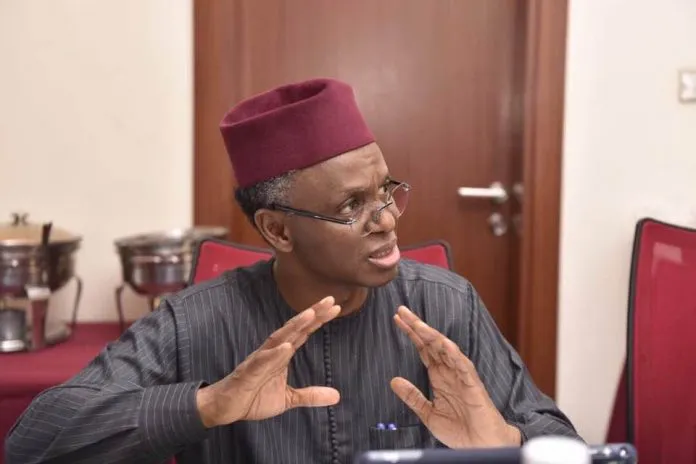
Dressed in a light green babanriga with a cap, he was heavily guarded as operatives of the ICPC and the Department of State Services formed a protective cordon around him while ushering him into the courtroom.
Journalists were, however, barred from gaining access to the courtroom by security operatives.