By Luminous Jannamike, ABUJA
At the Shehu Musa Yar’Adua Centre, a simple question from Kenneth Okonkwo now sits at the heart of a growing political storm.
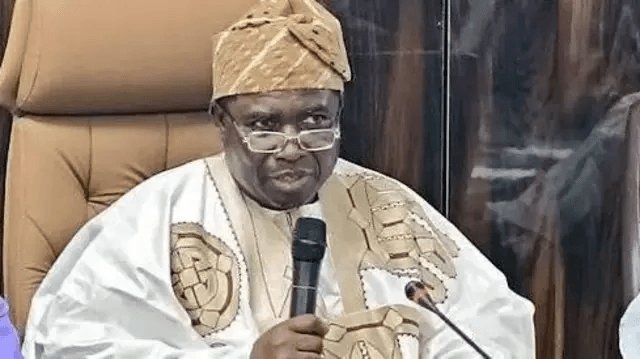
On Thursday, at the open entrance of the Shehu Musa Yar’Adua Centre in Abuja, Kenneth Okonkwo; lawyer, veteran Nollywood actor and political voice, stands still, but the moment around him is not.
Dressed in a simple dark traditional outfit and a patterned grey cap, he carries quiet authority. His face holds the moment; eyes slightly widened, brows raised, as though every word must land.
He leans forward, just a fraction. Not aggression. Not performance. Insistence.
Around him, the space is bright and open; pillars, polished floors, small clusters of silent observers. Everything is still. But not at ease. There is tension in the air, the kind that settles just before something shifts. Then Okonkwo speaks.
“How?” he asks. “How can ‘status quo ante bellum’ mean a political party has no leadership? What was the state before the conflict? Has there ever been a time the ADC had no leadership?”
By now, the Latin has faded. The argument is no longer legal. It is something simpler, and harder to ignore. And in that moment, Okonkwo is no longer just asking a question. He is framing the conflict.
From where he stands, Okonkwo watches as former Senate President and embattled National Chairman of the African Democratic Congress, ADC, Senator David Mark steps forward. By then, the indoor halls had already outgrown their purpose.
People line the walls. Others stand outside, straining to hear. Around Senator Mark are some of the country’s most recognisable political figures: former Vice President Atiku Abubakar; former governors Peter Obi, Rabiu Kwankwaso, Rauf Aregbesola, Liyel Imoke and Rotimi Amaechi; senators including Aminu Tambuwal and Dino Melaye, alongside other opposition figures, party supporters and activists, a quiet signal that this is no ordinary dispute.
The crowd is so large the briefing is pushed outdoors. Okonkwo does not speak again. He watches.
“There is only one conclusion Nigerians can draw. The electoral umpire has taken sides. It can no longer be trusted,” he says.
Then he raises the stakes.
“With 90% of the National Assembly and over 30 governors, what are you afraid of?” he asks President Bola Ahmed Tinubu.
It is less a question than an accusation, and everyone present knows it. The space tightens. Okonkwo’s earlier question lingers in the air, now amplified.
At the centre of the storm is a single move. Between Wednesday and Thursday, INEC removed the names of David Mark, Rauf Aregbesola, and the entire ADC National Working Committee from its portal. It also stepped back from recognising or monitoring any faction of the party.
From where Okonkwo stands, the effect is immediate, even if the action itself is administrative. On paper, it is compliance. In reality, it changes the terrain.
INEC says it is acting on a March 12 Court of Appeal order to maintain the ‘status quo ante bellum.’
But its interpretation has triggered a political shockwave. By reverting to a period before the current leadership was recognised, the commission did not just pause a dispute, it erased its present form.
No leadership acknowledged. No faction recognised. No official engagement. To INEC, it is neutrality. To those gathered, it raises a different question: neutrality for whom?.
Behind the scenes, the commission’s logic is procedural. Past electoral disputes have shown how intervention can unravel elections later. So INEC steps back.
Just distance. But as Okonkwo watches events unfold, the implications are harder to ignore. In politics, distance does not always mean absence. Sometimes, it reshapes the field.
The document, the timing and the quiet contradiction
There is, however, a detail that remains difficult to ignore. The March 12 Court of Appeal order did not expressly instruct INEC to withdraw recognition from any leadership. It called for preservation, not subtraction.
Yet within days, the commission removed the names of David Mark and Rauf Aregbesola, effectively creating a vacuum.
Legal practitioners familiar with electoral disputes say that distinction matters. Maintaining a status quo typically implies freezing an existing condition, not dismantling it.
The timing adds another layer. The delisting came just days after Rabiu Kwankwaso and millions of members of the Kwankwasiyya movement defected to the ADC from the NNPP, and just before the defection of Bala Mohammed, along with the entire state structure from ward level upwards, to the ADC, as well as ahead of the party’s scheduled congresses, a critical phase that determines control before the primaries.
INEC has not publicly clarified whether alternative interpretations of the court order were formally considered, or why the most far-reaching option was chosen.
That silence leaves a narrow but significant gap. Not proof of bias.
But space for suspicion.
Within the party, the reaction is immediate. Bolaji Abdullahi, the National Publicity Secretary, frames it as a line that cannot be crossed.
“There’s no way we could have anticipated they would go this far. Now that they have come this far, we are not going to yield because yielding makes us complicit in fostering dictatorship. Our duty is to Nigeria and to Nigerians. This is another test to democracy and we are going to be firm and resilient,” he says in an exclusive interview.
But the risk is clear. Without INEC recognition, every step forward exists in uncertainty.
Okonkwo remains in the background, but the question he raised continues to define the moment.
Hard facts, Timelines and The Numbers Shaping the Crisis
The timeline tells its own story. On September 9, 2025, the leadership led by David Mark was formally recognised by INEC.
Months later, on March 12, 2026, the Court of Appeal issued its order directing all parties to maintain the ‘status quo ante bellum.’
Within days of that ruling, INEC acted. The names of Mark, Rauf Aregbesola, and the entire National Working Committee disappeared from its portal, effectively undoing that earlier recognition.
Now, the clock is ticking. The ADC’s congresses are set to begin on April 9. Primaries will follow from April 23 to May 30, with party registers due by May 10.
Each of these steps is more than routine. They determine who controls party structures, and ultimately, who appears on the ballot. All of it is unfolding in a political landscape dominated by the ruling APC. INEC insists it is maintaining neutrality.
But as Kenneth Okonkwo’s opening question suggests, neutrality; when it leads to consequences this significant, rarely feels neutral to those living through it.
The ruling party sees it differently. Its spokesman, Felix Morka, describes the situation as “self-inflicted.” From that view, the crisis belongs to the ADC, not the commission. But among those gathered, that distinction feels far less settled.
Many see irony and betrayal in the unfolding drama:
Peter Obi, former presidential candidate: “Yesterday defenders of democracy, today’s destroyers. What a shame. Power indeed reveals character. What an irony of history, that the acclaimed defenders of democracy and human rights who claimed to have fought for democracy during the era of General Sani Abacha now find themselves worse than the man they opposed.”
Some express deep distrust in both institutions and opposition:
Chinonso Okonkwo, social commentator: “I don’t even trust ADC to restore anything to this country in the first place, but inec nigeria trying to remove David Mark as ADC national chairman is a bias stand and it clearly shows they are bought over even before election begins. It’s a shame inec nigeria can’t be trusted.”
Others question the logic behind the decision:
Olalekan Wills, concerned citizen: “So, the status before the war was ADC without leaders you mean? Can someone pls enlighten me. This clearly shows inec nigeria and Joash have really taken sides.”
Anger and frustration are also evident:
Ikpet Ebogha, civil engineer: “When we know how our courts are in nigeria. This INEC chairman must resign now.”
Blessed Nkemakonam, activist voice: “(Amupitan) Don’t worry. If this country burns, your name will be on the history books that you helped facilitate it.”
Amoro Osomave Ekine, political observer: “INEC chairman shouldn’t resign but be relieved of his position having taking sides in party dispute under a court of competent jurisdiction,the court never order the chairman not to recognize any faction of Adc but stated that both faction should maintain status quo,INEC chairman is biased in implementing court decision which didn’t accord him that solitary right,that’s to tell u, he’s isn’t here to conduct credible elections but to manipulate the system in favour of his pay master.”
Chukwuma Gideon, public respondent: “INEC chairman has already taken side. He should resign for interfering in party affairs.”
Mustapha Abdullahi Akpaki, civic voice: “INEC needs to offer convincing explanations to the delisting of the David Mark led ADC else their action will be largely interpreted as being partisan.”
Some emphasise legality and political strategy:
Abubakar Yunusa, political strategist: “INEC has no powers to delist the names of the David Mark led ADC leadership from its website (portal). Therefore, the ADC should continue to consolidate on its base across Nigeria’s six geo-political zones, 36 States, and 774 LGAs.”
Aayan Yasin, citizen commentator: “INEC’s shameful delisting of David Mark-led ADC is pure partisan sabotage, not neutrality. This desperate plot to kill emerging opposition ahead of 2027 exposes their bias.”
Long after the gathering thins, Okonkwo’s question remains. Not legal. Not procedural. Fundamental.
If a system can step back so far that leadership disappears, what does that mean for those who stand behind it?
“How can ‘status quo ante bellum’ mean a political party has no leadership? What was the state before the conflict? Has there ever been a time the ADC had no leadership?” Okonkwo asked it at the beginning.
By the end, no one has answered it. And in a moment like this, silence is not empty. It is an answer of its own.