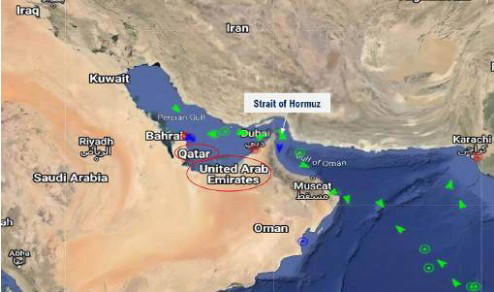
Iran says the Strait of Hormuz is open to shipping from all friendly countries.
“From our point of view, the Strait of Hormuz is not closed, particularly not to friendly nations.
“It is closed only to our enemies,” said Foreign Minister Abbas Araghchi on the sidelines of the BRICS foreign ministers’ meeting in New Delhi on Friday.
Iran’s chief diplomat also surprisingly held out the prospect of lifting restrictions imposed by the Iranian navy.
Araghchi said this was conditional on the ending of the war that the U.S. and Israel launched against Iran at the end of February.
“Then we will ensure that safe passage is guaranteed for every single ship,” he said.
Shortly after the war began, Iran’s armed forces took control of the Strait of Hormuz, which is vital for energy trade.
Threats, inspections, and attacks on ships brought traffic in the strait largely to a standstill.
The result was a significant rise in energy and fuel prices worldwide. According to Iran, the strait has also since been mined.
Tehran consistently emphasizes that the Strait of Hormuz is not blocked.
In practice, however, shipping companies must coordinate with Iranian contact points and are subsequently only permitted to pass through a corridor near the Iranian coast.
The Iranian leadership demands high fees for this. International law experts say such fees violate the right of transit passage.
For their part, the U.S. imposed a naval blockade against Iran in mid-April in order, among other things, to cut off the country’s oil revenues.