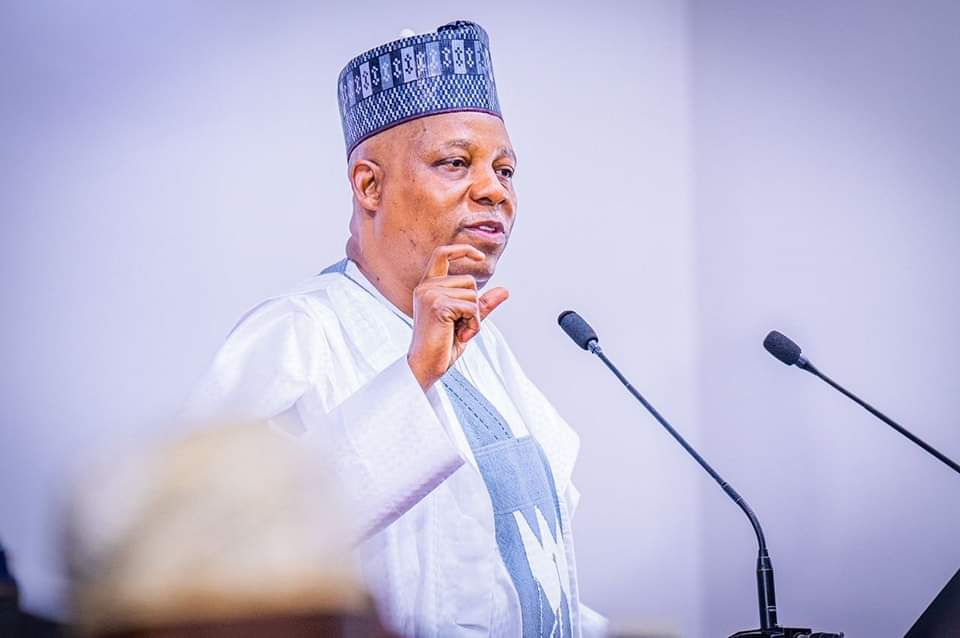
Vice-President Kashim Shettima says the late Brigadier Musa Usman laid critical foundations for the development of the North-East, particularly through the transformation of Maiduguri into a modern regional capital Shettima stated this on Monday in Abuja while speaking through his representative, Aliyu Mudibo, at the public presentation of Service and Impact: Brigadier Musa Usman 1940–1991, a book documenting the life, career and legacy of the late military administrator. The Vice President said Musa Usman played a crucial role in establishing a functioning state and developing Maiduguri through investments in roads, railways, government institutions and residential districts.
“Brigadier Musa Usman stood at a crucial point in that history. He helped establish a functioning state, develop Maiduguri as a regional capital, and nurture cooperation among communities that now inhabit six states,” he said. Shettima, a former governor of Borno State, said successive administrations had built on the foundations established by the late military administrator. “Successive administrations built upon these foundations, and as Governor of Borno State, I inherited both the achievements and responsibilities of those who came before me,” he said. He said the development of the region had continued under the administration of the current Borno State Governor, Prof.
Babagana Zulum, despite the challenges confronting the state. “Today, under my brother and successor, Professor Babagana Umara Zulum, reconstruction and development continues, despite the challenges of the time,” Shettima said. The Vice President described Musa Usman’s legacy as a lesson for contemporary leaders, urging them to embrace selfless public service and pursue development beyond political considerations. He called on leaders to apply the principle of selfless service to reconstruction, agriculture, education, transportation, energy, industrialisation, employment, environmental restoration, peace and security.
“We must build beyond the next elections and think beyond political boundaries,” Shettima said. ” Shettima also said the book would contribute to preserving Nigeria’s national memory by documenting the contributions of individuals who shaped the North-East. “The North East we know today was shaped by administrators, public servants, traditional rulers, business people, farmers, teachers, and ordinary citizens,” he said.
Speaking at the event, the governor of Borno State, Babagana Zulum said Musa Usman combined integrity with impactful governance, adding that the late military administrator laid foundations in education, healthcare and the economy on which the six states of the North-East continued to build. The governor said Usman also invested in infrastructure and introduced initiatives to unlock the region’s economic potential, including the establishment of the Ashaka Cement project. “What makes his record particularly worthy of remembrance is not only the number of projects undertaken, but the character with which he served,” Zulum said.
He described Musa Usman as a leader known for integrity, modesty, discipline and an uncommon sense of duty, saying he belonged to a generation that regarded public office as a responsibility rather than a privilege to be exploited. “The title of this book, Service and Impact, is therefore most appropriate,” Zulum said. “Service without impact is incomplete, while impact without integrity cannot endure. “Brigadier Musa Usman combined both. He served with honour, and the consequences of his service remain visible decades after his departure from office,” he added. ) Ike Omar Sanda Nwachukwu, described the book as a reminder of the sacrifice involved in military service.
Nwachukwu said service required individuals to place the safety, security and freedom of others above personal comfort and, in some cases, survival. “It is an acknowledgement that there is something greater than the individual,” he said. He also paid tribute to Musa Usman’s wife, Jumai, for keeping the family together over the years and described the event as an opportunity to honour the late brigadier’s contributions to the Nigerian Army, Nigerian Air Force, the former North-Eastern State and Nigeria. “Fare thee well, Musa, where you are in the heavens.
Intercede with the Almighty God to make Nigeria a place where we all become to call our home, a place where religion, ethnicity, creed don’t matter,” Nwachukwu said. Speaking on behalf of the family, Hassan Musa Usman, thanked the dignitaries and guests who attended the event, saying their presence constituted a tribute to his late father. Hassan said the idea for the book came from their mother, Hajia Chioma Jumai Usman, who believed that Musa Usman’s life needed to be documented. He said his late sister also played a major role in bringing the project to fruition before her death just over a year ago. “We complete this work today in her honour and in his as well,” Hassan said.
He said the book sought to document not only Musa Usman’s military career but also his vision and legacy. Hassan noted that Musa Usman became governor of the former North-Eastern State at 27, despite initially setting out to become a soldier rather than a statesman. “He set out to be a soldier, not a statesman. Yet, at the age of 27, he found himself governor of the North Eastern State, the largest subnational landmass in the country,” he said. He added that Musa Usman governed the region for eight years, learning on the job while managing six states with immense diversity and more than 100 ethnic nationalities.
One of the authors, Theophilus Abbah, said the research team accessed key personalities through the goodwill of former Head of State, General Yakubu Gowon. “We were able to accomplish this because of the goodwill that General Gowon had. If he hadn’t had that goodwill, we wouldn’t have been able to access the people that we had to interview,” Abbah said. Another author, Mallam Mahmmud Jega, said the researchers found extensive records of Musa Usman’s activities. “We found the records were intact – all the speeches, the National Memorial programmes, and everything,” Jega said.
He said the authors also relied on newspaper reports and archives, particularly those of the New Nigerian and other newspapers published during the period. Jega commended the Borno State History Bureau for preserving speeches, photographs and other historical materials documenting the activities of Musa Usman and other governors of the period.