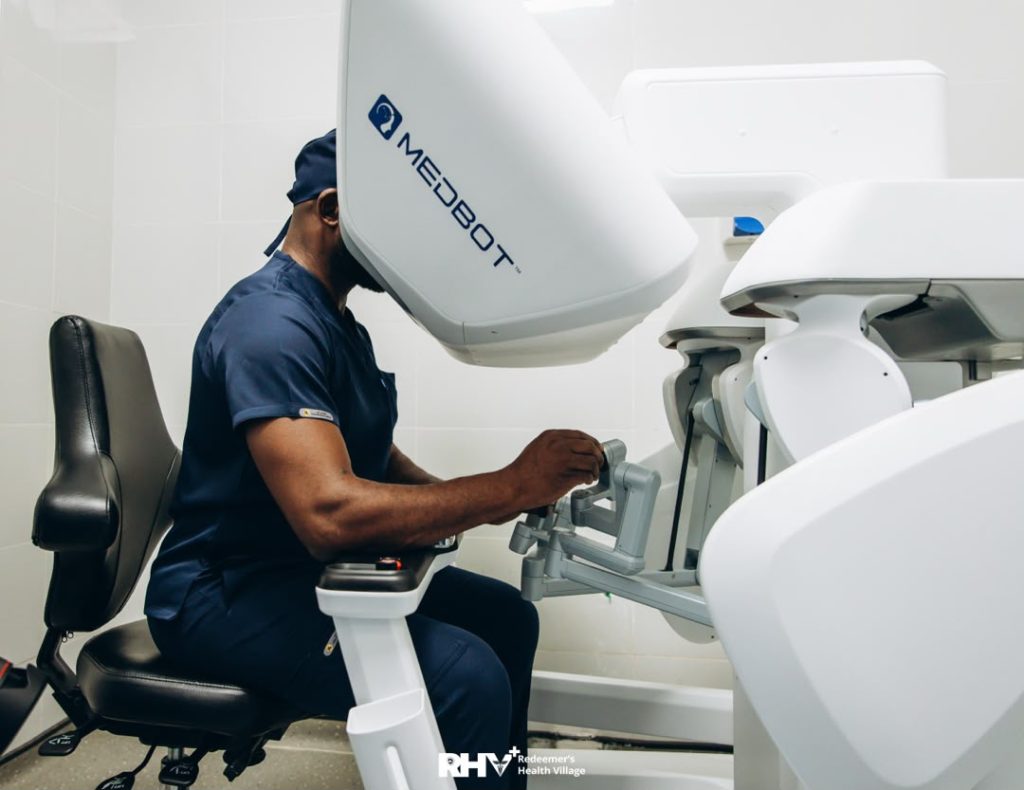
A new chapter opened in Nigeria’s healthcare system at the weekend as surgeons at Redeemer’s Health Village (RHV) Hospital, Lagos, in collaboration with Nisa Premier Hospital, Abuja, successfully performed what they described as the first tele-robotic surgery in West AfricaThe landmark procedure saw a surgeon in Lagos remotely operate on a patient undergoing surgery at Nisa Premier Hospital in Abuja, demonstrating for the first time the possibility of delivering complex surgical care across hundreds of kilometres without the operating surgeon being physically present at the patient’s location.
The procedure, witnessed by selected journalists at RHV in Lagos, involved a patient with a kidney tumour in Abuja. Using robotic surgical technology and a high-speed internet connection, the surgical team in Lagos controlled the robotic system at the Abuja hospital to perform the operation. “The second procedure we did was a tele-surgery procedure where we were able to operate on a patient in Abuja, 500 kilometres away. We were able to operate on a patient with a kidney tumour, a cancer tumour. ”The tele-robotic operation followed another robotic procedure performed on a 28-year-old woman who had lived with a congenital obstruction affecting the drainage of her kidney.
Speaking with journalists shortly after the surgeries, the Chief Executive Officer of RHV Hospital, Dr Adedamola Dada, said the patient’s condition had placed her kidney at risk of permanent damage. “For those of us who were in the theatre, it was pretty obvious immediately that the obstruction was removed. The urine started flowing very freely,” Dada said. “For me, the most important thing is the quality of the work that has been done. ”Dada said the significance of the development went beyond the two patients, arguing that remote robotic surgery could expand access to highly specialised medical care in Nigeria.
”The RHV chief executive also said the technology could help reduce the pressure of medical tourism by allowing Nigerians to access advanced procedures locally. He disclosed that RHV was also developing a robotic academy to train surgeons, operating theatre nurses, biomedical engineers and other specialists needed to sustain robotic surgery in Nigeria. Also, Chairman of the Board of RHV Hospital, Dr Kunle Onokoya said robotic surgery represented a major evolution from conventional surgical procedures. “Fast forward to today, the patient is going to go home today, worst case tomorrow. Bleeding is minimal,” Onokoya said.
“The robot is still being controlled by a human being, by a very, very experienced and senior surgeon. It is just that the skills of that surgeon are now being magnified many times over by the robot,” he said. Davis- Ekwenna said the achievement was the result of collaboration between Nigerian surgeons, engineers, nurses and international partners. “Our engineers were Nigerians, our surgeons were Nigerians, the nurses are Nigerian,” he said. According to him, the team hopes to train at least 150 surgeons in robotic surgery within the next two years. He added that robotic surgery offers patients less pain, fewer complications, reduced infections and faster recovery.
“We just scratched the surface today to show that this can be done. Patients in Nigeria, regardless of where they live, can have access to the best surgical care in the world here in Nigeria, done by Nigerians,” he said.