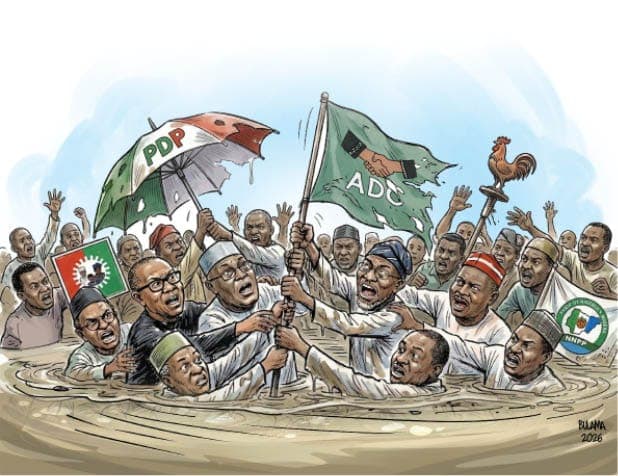
The Independent National Electoral Commission (INEC), on Wednesday, took a decision on what observers say could seal the fate of one of the major opposition parties in the current dispensation: the African Democratic Congress (ADC).
Since 2023, most of the opposition parties that held sway during the late president Muhammadu Buhari administration, mainly the Peoples Democratic Party (PDP) Labour Party (LP) New Nigeria Peoples Party (NNPP) and the Social Democratic Party (SDP) have all been engulfed in crises just as they have been fractured to pose any serious threat to the ruling party, the All Progressives Congress (APC).
Due to the pattern, pundits have ruled out the claim that the recent INEC decision concerning the ADC could be mere coincidence. saying the frequency and fervency with which they occur point at a plot to keep them down.
Analysts suggest that though ruling parties in Nigeria have in the past tried to outdo the opposition, the concentration has been on going into alliances and strengthening their turf; not putting fire in rival parties.
The PDP crisis started before the current administration in the build up to the 2023 presidential elections and the leaders were not able to resolve, but allowed it to linger till it started threatening the chances of the party ahead the next elections.
After failing to resolve the crisis within the PDP, leaders of the PDP like former vice president, Atiku Abubakar, former Senate President, David Mark, former governor of Osun State, Rauf Aregbesola and others left the party in droves and registered with the ADC and took over its structures.
The ADC has been in existence for 20 years and has been fielding presidential candidates in previous elections, but the movement of Atiku and others boosted the image of the party and at a time shot it to the position of the major opposition party in Nigeria.
The ADC became the major rallying point for opposition politicians, offering its platform to those with presidential and other ambitions who were not sure of standing in other parties.
Within months, the party has gone ahead to bring all the three presidential candidates of the parties that came tops after the APC in the 2023 elections: Atiku of the PDP, Peter Obi of the LP, and Rabiu Musa Kwankwaso of the NNPP together in what has been described as a formidable coalition of forces strong enough to threaten the APC.
In 2023, the three went their separate ways with each garnering substantial votes that analysts say, if put together, could have overtaken the number of votes polled by Tinubu to be declared winner of the elections.
Atiku was the first of the trio to join the ADC, followed by Obi. Kwankwaso had been dilly-dallying as he was said to be making consultations. But last week, he formally joined the ADC, boosting the strength of the party.
Add to that,the ADC which has no sitting governor began to receive a favourable signal from the governor of Bauchi State, Bala Mohammed, that he might resign from the PDP and join the ADC.
This would have translated into a big boost for the opposition, as it would have all the advantages accruing to having a governor on its side in addition to the federal law makers that joined the party and other prominent politicians aspiring for the governorship seats in various states.
But that suffered a setback when INEC took a decision to de-recognise the leadership of the ADC, lead by former Senate President, David Mark
The electoral body said after “a careful review” of the appellate court’s ruling delivered on March 12, 2026, as well as the pending suit before the Federal High Court in Abuja, it “resolved to maintain the status quo ante bellum in compliance with the judgment of the Court of Appeal and in deference to the ongoing proceedings before the Federal High Court.”
“The commission has also declined the request to allow Hon. Nafiu Bala Gombe to take over the affairs of the party pending the court’s decision, stressing that it “will not receive further communication from, or deal with, any of the contending groups on matters relating to the party’s affairs,” and “will not monitor any meeting, congress or convention convened by any faction of the ADC until the case is determined.”
INEC subsequently removed from its portal the names of the National Working Committee members of the ADC led by Senator David Mark.
This has been given various interpretations as many see it as a deliberate attempt by the ruling party, using the INEC to stifle the opposition; a development that led to calls for the removal of the INEC chairman, Prof Joash Amupitan.
Various commentators have said that this is a most difficult period for the opposition as they have been visited by many problems directly and indirectly linked to the ruling party.
Our correspondents noted how each of the major opposition parties had been visited with crises that have left them fractured over time.
Since the Federal Capital Territory, FCT Minister Nyesom Wike declared his intentions to support President Bola Ahmed Tinubu after the presidential primaries of the PDP in 2022 won by former Vice President Atiku Abubakar, the PDP has not known peace.
Wike’s insistence on going with Tinubu in the next general election has also left the party in disarray.
First, it was the issue of the tenure of the acting national chairman, Umar Damagum, before he later became the substantive national chairman.
Then came the issue of a national convention and the crack appeared. One chose to hold the national convention in Ibadan, Oyo State, while the other side disagreed.
Before, the Ibadan convention in November last year that was nullified by the court, the PDP governors wanted the party to present its own presidential candidate in 2027. The situation polarised the National Working Committee led by Damagum into those in support of the governors and Wike.
The development led to the factionalisation of the party. Even before the Ibadan Convention was nullified, the Independent National Electoral Commission, INEC had already recognised the National Caretaker Committee under the leadership Abdulrahman Muhammed, backed by Wike.
All efforts by leaders of the party for a unity national convention failed as the Wike faction felt they had defeated the Kabiru Tanimu Turaki faction.
The situation led to the break down of peace moves, a development that led the Turaki-led group to appeal the judgment of the Appeal Court and the Supreme Court.
Recently, the Wike group held its convention in Abuja attended by some leaders of the party, even though the Turaki group rejected the development.
INEC has also recognised the group as the authentic PDP leadership, even though the case is still in the court.
The internal crisis rocking the New Nigeria People’s Party (NNPP) has continued to deepen, with rival factions at both the national and Kano state levels trading accusations and suspicions of external interference.
At the federal level, the party is split between the camp loyal to former presidential candidate and ex-Kano governor, Senator Rabiu Musa Kwankwaso, and another faction led by Dr. Boniface Aniebonam, one of the party’s founding members.
While Kwankwaso’s group insists on reforms that give him greater influence over the party structure, Aniebonam’s faction accuses him of hijacking the NNPP and sidelining its original leadership.
They specifically accused Kwankwaso of changing the party logo from its original fruits to book, something they said was done without their approval.
In Kano, the crisis has mirrored the national divide. The state chapter is split between the faction loyal to Governor Abba Kabir Yusuf, a Kwankwaso protégé, and another group led by Alhaji Abdullahi Raji, who claims to represent the interests of the founding members.
Both sides have held parallel meetings and issued conflicting statements, further confusing party supporters. The government’s side then had Hashimu Dungurawa as leader, while the Aniebonam faction had Mas’ud Doguwa as state chairman.
The crisis, which began shortly after the 2023 general elections, has since escalated into litigation, with multiple court cases challenging the legitimacy of party executives.
Earlier in January, the only governor in the party, Kano’s Yusuf dumped it for the ruling APC, parting ways with his former political godfather, Kwankwaso. Just last week also, Kwankwaso dumped the party for ADC, thereby leaving it with no elected official as they all decamped either to the APC or ADC.
The Independent National Electoral Commission (INEC) has been cautious in recognising either faction, often waiting for judicial pronouncements before taking a position.
Meanwhile, some NNPP leaders alleged that the APC-led federal government was exploiting the divisions to weaken the party’s influence, particularly in Kano where NNPP posed a strong challenge in 2023.
APC officials, however, have consistently denied involvement, describing the NNPP’s troubles as self-inflicted.
Observers note that the prolonged crisis has weakened NNPP’s credibility as a united opposition force, reduced its bargaining power in coalition politics, and left many of its grassroots supporters without focus.
The Labour Party (LP) has been through a protracted leadership crisis, conflicting court orders and a flurry of petitions by rival factions.
From parallel leadership structures to courtroom battles and physical confrontations over party assets, the LP has remained operational largely through its state chapters and elected public office holders, even as its national leadership is being contested.
The crisis reached a critical point when a Federal High Court in Abuja ordered the Independent National Electoral Commission (INEC) to recognise the Nenadi Usman-led caretaker committee as the authentic leadership of the party. The court directed INEC to “forthwith recognise the Nenadi Usman-led Caretaker Committee as the only valid authority to represent the Labour Party.”
Justice Peter Lifu, who delivered the judgment, ruled that the tenure of the Julius Abure-led National Working Committee had elapsed, declaring that the caretaker committee remained “the only valid authority” pending the conduct of a national convention.
While the Usman-led committee anchored its authority on the court ruling and earlier judicial pronouncements, the Abure faction rejected the decision and proceeded on appeal.
In its reaction, the Abure camp argued that “the judgment was a clear contradiction of the Supreme Court judgment,” insisting that “no court has the power to appoint leadership for any political party.”
Both factions have also sent petitions to INEC, each seeking official recognition as the legitimate leadership of the party.
While the caretaker committee insists that all correspondence with INEC must be routed through it in line with the court order recognising it “as the valid and only recognised” leadership, the Abure faction has urged the commission to disregard what it described as judicial interference in party affairs.
The development has placed INEC in a delicate position, as it navigates competing legal claims and interpretations.
On the ground, the crisis has manifested in the emergence of parallel party structures and occasional confrontations.
Members of the caretaker committee accused the Abure faction of forcibly taking over the party’s national secretariat and removing sensitive documents, describing the action as “uncivilised,” while the Abure camp insists it remains in lawful control.
The struggle for control has also seen symbolic actions, including the pulling down of factional campaign materials and attempts to assert dominance over party offices.
Despite the divisions, the party has managed to survive through a decentralised structure, with many state chapters continuing routine political activities independent of the national leadership dispute.
Elected officials under the party’s platform have also maintained their positions, providing a semblance of continuity for the party.
However, observers warn that this survival is fragile and may not be sustainable without a resolution of the leadership crisis.
With appeals pending, petitions unresolved, the Labour Party faces an uncertain future.
Observers say a credible and widely accepted national convention may be the only pathway to restoring unity and preventing further fragmentation.
Until then, the LP remains a party surviving, but deeply divided as legal battles and political brinkmanship continue to define its existence.
With the position of the INEC, the ADC is practically without a leadership at the moment.
The issue has been in court with a former National Deputy Chairman, Nafiu Bala, claiming leadership of the party.
There is also the Issue of Dumebi Kachikwu, who has also been in court over the way and manner the party was taken over by the Mark leadership.
If the party resolves its court cases, it will have to settle who among the opposition leaders is put up to challenge President Bola Tinubu and how to keep the others happy after the primaries.
Before now, the party has been having issues with some state chapters over the composition of the State Executive working committees.
Don’t blame Tinubu, INEC for your woes – APC
The All Progressives Congress (APC) has urged the leaders of the ADC to look inward instead of blaming their predicament on President Tinubu or INEC.
APC’s National Secretary, Senator Ajibola Bashiru, while addressing journalists at the party’s secretariat in Abuja, said instead of the party’s leaders to address the pending case bordering on their legitimacy in court, “they prefer to embark on propaganda through press conferences”.
He dismissed the allegation that President Tinubu was planning to turn the country into one party system, saying it would be unfair to make such allegations when “the opposition themselves had failed to put their houses in order”.
Bashiru added that the ADC’s call for the sack of the INEC chairman and other national commissioners is laughable, wondering if “the commission was the one that told them not to follow their case to conclusion at the court”.
He noted that the party will still cry foul by the time they face the consequences of their decision to go ahead with their convention despite the outstanding court case, linking such to the PDP convention conducted in Ibadan despite court injunction.
Our hands are clean— Prof Amupitan
Chairman of the Independent National Electoral Commission (INEC), Prof. Joash Amupitan, on his part said the commission’s hands are clean as what it did was merely to comply with subsisting court orders.
Amupitan, in an interview with Arise TV, said INEC only interpreted the Court of Appeal’s directive ordering parties to maintain “status quo ante bellum” pending the determination of the substantive suit before the Federal High Court.
“If they are saying we have taken sides, that is not true, because if you look at the status quo ante bellum, we tried to interrogate it, and it means the status before the hostility started, the status before the war.”
He warned the ADC against holding its planned congresses and national convention without the commission’s oversight.
“If they are going ahead with their congress, with their convention, it’s left for them to look at it, whether it is in contravention of the court. INEC didn’t just take a decision. We didn’t just wake up one day and took this decision. There was something that led to it”, he said.
He said what is causing the controversy, is the order, specific order, that parties should maintain status quo ante bellum and that the parties should not do anything that would force a fait accompli on the trial court. “And finally, parties should not do anything that will render the proceedings before the court nugatory,” he said.
He explained that the lawyers for Nafiu Bala argued that INEC’s decision to invite the David Mark faction for political party meetings amounted to violation of the Court of Appeal ruling.
Amupitan said concerns heightened when the David Mark faction notified INEC of plans to proceed with primaries and congresses scheduled for April 9, 2026, despite pending litigation.
He stressed that proceeding with congresses while a motion seeking to restrain such activities remained pending before the Federal High Court could undermine judicial authority.
“When I look at the motion that was already pending before the Federal High Court, that INEC should not monitor any meeting, congress or convention, if you go back to the order of the Court of Appeal, none of the parties should do anything that will force a situation of failure to comply on the court,” he said.
You’re not the court, ADC tells INEC
The African Democratic Congress (ADC) on its part, rejected claims made by the INEC chairman.
The party, in a statement by its National Publicity Secretary, Mallam Bolaji Abdullahi, described the position of INEC as “willful distortion of the Court of Appeal’s directive to maintain the status quo”.
ADC accused INEC of overstepping its supervisory role and attempting to halt lawful processes, insisting that internal disputes do not suspend democratic functions, while reaffirming its decision to proceed in full compliance with the law.
The party said while the commission seeks to present its position as one anchored in law and neutrality, the substance of the chairman’s statements reveals “a fundamental misapplication of both constitutional principles and judicial directives.
“First, the chairman’s repeated assertion that INEC is merely acting within the confines of a “multi-party constitutional order” is, with respect, a deflection from the central issue. The question before Nigerians is not whether Nigeria remains a multi-party state in theory, but whether the actions of INEC in practice are undermining the ability of opposition parties to freely organise and function.
“The ADC has not alleged the abolition of multi-party democracy in form; rather, it has raised concerns about actions that, in effect, weaken it. The chairman’s reliance on the existence of multiple parties as proof of neutrality does not address the specific conduct under scrutiny.
“On the issue of the Court of Appeal’s order, the chairman places heavy reliance on the doctrine of status quo ante bellum, suggesting that it requires a rollback to a particular point in time and a suspension of party activities. This interpretation is both selective and legally flawed. The preservation order, by its nature, is intended to prevent actions that would irreversibly alter the subject matter of litigation, not to paralyse the internal functioning of a political party”.
The ADC said the chairman’s claim that holding congresses or conventions would “render proceedings nugatory” is an overreach as internal party processes, conducted in line with the party’s constitution and the Electoral Act, do not extinguish or prejudice pending judicial proceedings.
The party said the assertion that INEC is restrained from monitoring congresses due to an injunction equally exposes a critical misunderstanding of its role.
“INEC’s duty to monitor is statutory and triggered upon proper notification. A party’s decision to proceed with its internal processes does not depend on INEC’s participation. By conflating its monitoring function with the validity of the processes themselves, INEC effectively places itself above the law, assuming a veto power it does not possess.”
On the invocation of precedents such as Zamfara, the ADC said the comparison is misplaced.
The ADC reiterated that its right to organise congresses and hold its national convention is constitutionally guaranteed and has not been lawfully suspended by any court saying the interpretation advanced by the INEC chairman stretches judicial directives beyond their meaning and risks setting a dangerous precedent where regulatory caution becomes a tool for democratic suppression and will therefore proceed with its activities in full compliance with the law.
Why we agree with INEC — Nafiu Bala
Bala Sani, the Chief of Staff to Nafiu Bala, who spoke to our correspondents on behalf of his boss, said the position of INEC is in line with the ruling of the Court of Appeal, the Judgment delivered on 12th March, 2026.
He said “as for us, INEC needs commendation for what they have done and some civil societies who put pressure on the INEC to do the needful”.
“I don’t know whether you are aware that there are some civil society organisations who went to INEC and demanded that INEC should implement and enforce the Court of Appeal ruling. So, as far as we are concerned, INEC has done the needful. INEC has implemented the ruling given by the Court of Appeal, that’s our position.
“What INEC did was to comply with the directives of the court and that’s where I want to make some clarification. The judgment of the Court of Appeal said the parties should maintain status quo ante Bellum. The clarification is that some people will tell you this matter started from the day Nafiu Bala went to court”.
Explaining what transpired between them and David Mark, Bala said “Some people will say it started when INEC recognised the David Mark group. But what may interest you to know, this child was born on 2nd July, 2027, That was the beginning, that was the status quo ante Bellum.
“Let me explain to you, we were called for a meeting, we cannot deny the David Mark group, we cannot deny them. We had a meeting with them. They called us for the final conclusion of the meeting before they joined the party.
“So, we were invited to meet with the coalition people at Yar’adua Center in Abuja. So when we came then, the former national chairman, Ralph Nwosu, made his welcome address and immediately after the welcome address, he declared his resignation.
“But, that was not what we were expecting from him. We were expecting Ralph Nwosu, when they called us for a meeting to tell us how far they had gone with the meeting and discussions, where we were and where were we going? So, Ralph Nwosu announced his resignation immediately. After he announced his resignation as the National Chairman of the ADC, he issued the membership card of ADC to Senator David Mark and Rauf Aregbesola, it was on Television and in the media, that was on 2nd July 2025.
“After that, Ralph Nwosu did not stop there. He went ahead and appointed David Mark and Rauf Aregbesola as the National chairman and National secretary of the party, respectively. This contravenes article 8-2 and article 9-4 of the ADC constitution as amended.
He said the constitution of ADC doesn’t allow Ralph Nwosu to appoint his successor, “when we have a deputy National Chairman on ground”.
Nafiu Bala said what they want to achieve is that the constitution of the African Democratic Congress be respected.
“So, if David Mark wants us to resolve this issue, since Ralph Nwosu resigned, Nafiu Bala, as a deputy national chairman constitutionally, he’s supposed to have been made the acting national chairman. So, when this is upheld, when the constitution of the ADC is upheld, Nafiu Bala becomes the national chairman, we will now opt for political negotiation and discussion, and dialogue, whatever name you call it.
“We are not saying we don’t like David Mark. We are not saying we are not going to work with them. But we are telling them, the process, the way, they entered the party is faulty. So, if they want to join ADC, the political party is for all Nigerians. Let them do the right thing, join the party properly, so that we can come and discuss with them. As it is, they are not members of ADC”.
ADC only needs to notify INEC about its convention – Lawyers
Lawyers said the political party has the right to pursue its internal affairs by notifying INEC, and its absence cannot make the process unlawful.
Reacting, Ebuka Nwaeze Esq said the Electoral Act prohibits a court from granting injunction restraining processes of election, therefore, no court can grant an interim injunction on the processes to produce an exco and a party candidate for an election because it will lead to using court to stop a party from participating in an election.
On the proposed convention/congresses, he said a political party only needs to invite INEC through the necessary notifications, and whether they attend or not does not invalidate the outcome.
“If ADC produces their organs and executive, and along the way, the Supreme Court interprets that what the Court of Appeal said does not mean that David Mark’s interim team is removed, then INEC cannot take it further. But if they say otherwise, that means INEC would be right all the way,” he said.
Similarly, Wisdom Elum Esq, said the interpretation that was given by INEC was not the correct one because “the Court of Appeal’s order to maintain status quo means as it was before they got to court.”
He added that the ADC should also weigh the political dimension of the INEC interpretation and brace themselves.
Current trend dangerous for democracy – Prof Jibrin Ibrahim
In his column which was published on Friday, a professor of Political Science and civil society activist, Jibrin Ibrahim, who wrote about the de-recognition of the ADC, warned on the dangers of the developments around opposition parties.
“From the day of his swearing in, President Bola Tinubu has been clear that the main purpose of his first term in office is to use it to obtain a second term. His method has been clear to all keen observers of Nigerian politics, to use the judiciary and INEC to take over the opposition parties so that his opponents would have no platform to contest against him. Surrogates have been used to take over and break the ambitions of his opponents in the Peoples’ Democratic Party (PDP), the Labour Party (LP) and the New Nigerian Peoples’ Party (NNPP) so far. This approach however had an unforeseen negative outcome for the ruling APC as all the disparate opposition groups were then pushed into one single formidable opposition party, the African Democratic Congress (ADC). This week, INEC was used as a tool to scuttle the ADC in spite of the lack of legal basis to do so.
“Section 83 of the Electoral Act 2026 provides that no court shall entertain suits relating to the internal affairs of a political party and imposes mandatory cost sanctions of not less than N10 million against both counsel and litigants who bring such suits. This is a major shift in the law. It is clearly aimed at reducing the growing number of court cases over party leadership, congresses, and internal fights often instigated by surrogates of the ruling party.
“The Independent National Electoral Commission (INEC) has suspended recognition of all leadership factions of the African Democratic Congress… INEC said its decision followed the directive by the Court of Appeal, directing that the two factions of the party maintain the status quo pending the determination of a substantive suit currently before the Federal High Court in Abuja. When did INEC become the interpreter of court judgements? In any case, INEC has in its files the resignation letters of the previous party leadership who left voluntarily and some of them are now trying to claim they never left,” he said.
He warned that the more government agents disrupt political platforms, the more Nigerians feel alienated from them.
Arewa Think Tank cautions opposition parties
The Arewa Think Tank on its part condemned calls for the removal of the Chairman of the Independent National Electoral Commission (INEC), Professor Joash Amupitan, describing the demand as unjustified and politically motivated.
Speaking on behalf of the group, its Convener, Muhammad Alhaji Yakubu, called for restraint among opposition actors, warning against actions capable of undermining Nigeria’s democratic institutions.
Yakubu stressed that, “the pursuit of political power must not come at the expense of democratic stability”.
Arewa Think Tank noted that, “the tenure and removal of the INEC Chairman are clearly defined under Section 157 of the 1999 Constitution and cannot be influenced by partisan pressure”.