In contemporary Nigerian politics, accusation has become easier than evidence. A single allegation, repeated often enough on social media platforms, suddenly acquires the appearance of truth. Facts are thus abandoned for sentiment. Propaganda replaces rationality. Political opponents become guilty long before objective scrutiny.
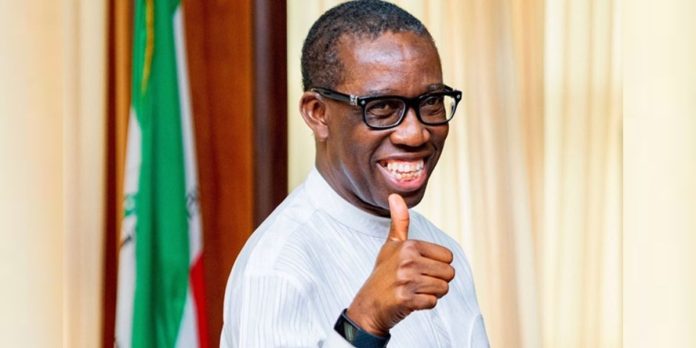
This is precisely the atmosphere surrounding former Delta State Governor, Dr. Ifeanyi Okowa. For months, a chorus of political adversaries and opportunists have sought to reduce his eight-year administration to the altar of sensational corruption claims. One particular dramatic allegation insists that as much as N1.3 trillion was stolen from the approximately N2.65 trillion that accrued to Delta State during his eight-year tenure. The implication is staggering. It suggests that nearly half of the entire resources available to Delta State between 2015 and 2023 vanished. This raises a fundamental question critics have consistently failed to answer:
How exactly was an administration allegedly deprived of almost 50 percent of its total revenue still able to execute one of the most expansive infrastructure and social investment programmes in Delta State’s history?
This is where propaganda collides with reality. Governance leaves footprints. Roads and bridges are visible. Salaries paid over eight years are verifiable. Hospitals exist physically. Airports are not imaginary. Drainage systems cannot be fabricated. Sporting infrastructure can be inspected. Pension arrears cleared are matters of public record. These are not abstract but realistic. They are tangible outcomes. Under Okowa’s administration, civil servants received salaries consistently for 96 uninterrupted months, including 13th-month salary packages in several years despite economic turbulence and national recession. Pension arrears and retirement benefits inherited from previous administrations, reportedly exceeding N35 billion, were substantially cleared. Local government workers and primary school teachers were also paid with relative regularity during periods when many states across Nigeria struggled to meet basic salary obligations.
Thousands of students benefited yearly from bursary programmes. Promotion arrears and leave grants were paid. Delta became one of the early states to implement the N30,000 minimum wage. These were not cosmetic interventions. They involved enormous recurrent expenditure commitments sustained over eight years. Beyond salaries and welfare, the infrastructure footprint of the administration remains difficult to ignore. From the dualisation of major sections of the Ughelli–Asaba Road to the construction of the iconic Koka Interchange in Asaba, the administration embarked on extensive urban renewal and intercity road expansion projects. Roads such as Maryam Babangida Way, Summit Road, Okpanam Road, DLA Road, Nnebisi Road, and several adjoining corridors significantly transformed the capital territory.
In Delta Central, major interventions occurred across Ughelli, Effurun, Udu, Okpe, and surrounding communities. In Delta South, riverine connectivity projects, including the Trans-Warri Ode-Itsekiri roads and bridges, sought to address decades of infrastructural neglect. In Delta North, extensive reconstruction and dualisation projects connected rural and urban communities alike. Hundreds of kilometres of roads were either newly constructed, rehabilitated, or expanded across the three senatorial districts. Bridges demanded by many communities for decades became realities under the administration. These included the Beneku Bridge linking Ndokwa East, the Obo River Bridge in Ogwashi-Uku, the Agbarho-Orherhe–Otokutu Bridge, the Okpare-Olomu Bridge, and the Effurun-Otor Bridge. These projects improved connectivity and economic movement across several communities.
Even historically isolated communities witnessed intervention. In Burutu, the entire township roads were paved. Massive drainage and flood control projects were also undertaken in Asaba, Warri, Effurun, and other flood-prone communities. The Asaba storm drainage projects alone addressed longstanding flooding concerns affecting residents and businesses. In the aviation sector, the transformation of Asaba Airport remains one of the most visible legacies of the Okowa administration. The airport received a new terminal, runway overlay, Instrument Landing System upgrades, Category 9 improvements, and night landing capabilities aimed at enhancing operational capacity. Warri Airport also witnessed rehabilitation efforts.
The Delta Line transport system was revived with over 130 new buses introduced into the state transport network. Modern bus terminals also emerged in key cities including Asaba, Warri, Ughelli, and Ozoro. Sports development received unprecedented attention. The Stephen Keshi Stadium in Asaba became one of the finest sporting facilities in Nigeria, hosting major continental and national competitions. Sports infrastructure also expanded across several local government areas. Healthcare infrastructure similarly expanded under the administration. The Delta State Contributory Health Scheme became one of the most ambitious state-backed healthcare insurance initiatives in Nigeria, with hundreds of thousands reportedly enrolled. Mother and Child Hospitals emerged in strategic locations including Asaba, Warri, Ekpan, Owa-Alero, and Ughelli. Primary healthcare centres were built and upgraded across multiple communities. Specialist facilities, dialysis centres, oxygen plants, MRI and CT scan facilities also formed part of the healthcare expansion efforts within the state.
None of this suggests that the administration was flawless. No government is beyond criticism. Citizens have every democratic right to demand transparency, accountability, and proper scrutiny of public finances. Questions about governance should never be suppressed. Public office holders must always remain accountable to the people. However, accountability must be rooted in facts, not political hysteria.
There is a dangerous trend in Nigeria where public discourse is increasingly driven by emotionally satisfying allegations rather than verifiable evidence. Once a political figure falls out of favour with certain interests, attempts are made to erase every achievement and reduce years of governance to simplistic slogans while clear evidence is deliberately ignored. This culture does not promote growth or development. Rather, it weakens democratic accountability because it replaces objective evaluation with mob sentiment.
If N1.3 trillion was truly stolen from Delta State, as alleged, then critics must explain how an administration supposedly operating with barely half its resources still managed to execute extensive projects across infrastructure, healthcare, sports, transport, education, and social welfare at a scale already acknowledged even by political opponents.
The burden of proof cannot rest on propaganda alone. Political disagreements must not become an excuse for historical revisionism.