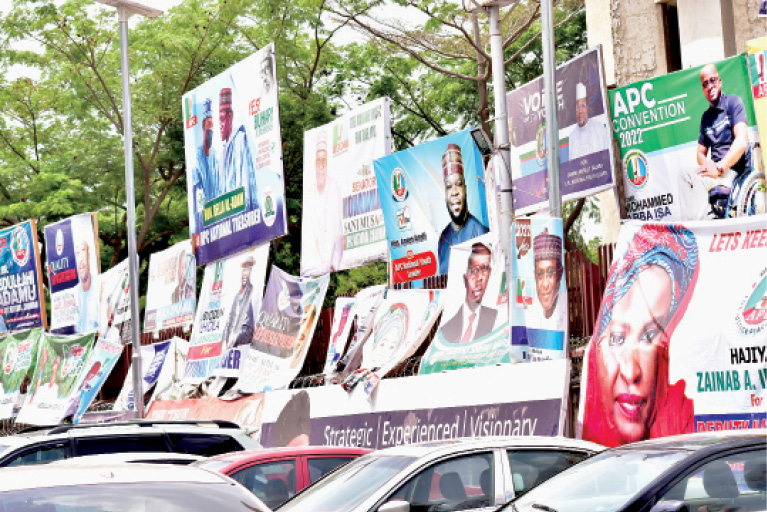
Nigeria is falling into a new political order, one in which power is more concentrated than at any point since 1999, and elections are increasingly fought through identity, money, and control of state machinery rather than ideas. The 2027 elections will be the first real test of this emerging system. If current trends continue, they could also be the most dangerous.
For much of the Fourth Republic, Nigeria’s democracy was anchored, however imperfectly, on multiple centers of power. The presidency was powerful, but it had to negotiate with regional blocs, party leaders, former military rulers, religious figures, and local godfathers. Informal norms like zoning and rotation mattered. Even when they were broken, they provided a language for contesting and reaching compromises.
Today, those guardrails are weakening. In their place, a more centralized order is emerging: a dominant ruling party, an extensive network of loyal governors, tighter control over key institutions, and a political culture that relies more heavily on ethnic and religious mobilization. The danger is not only that elections become less competitive but also that they grow more volatile. In the early 2000s, the issue was never that Nigeria’s president was weak. The issue was that he was not alone. Powerful regional godfathers and former military figures could influence and remove governors. The late Lamidi Adedibu’s role in the impeachment of Oyo governor Rashidi Ladoja, and the infamous saga of Chris Ngige’s abduction in Anambra, highlighted a chaotic yet plural system of power. No single actor could fully control the game. Two decades on, the landscape looks very different. The ruling All Progressives Congress (APC) now controls an unprecedented number of governorships and state legislatures. The pattern of defections since 2015, and especially after the 2023 elections, has been largely one way traffic into the ruling party. The more the APC expands, the weaker the organizational and financial strength of opposition parties at the national and state levels.
This matters because governors control more than just budgets. They shape security deployments in their states, influence local media narratives, mobilize traditional structures, and command the party machinery that determines who gets tickets and appointments. When one party controls a large majority of governors, it gains a structural advantage that extends well beyond campaign posters and rallies. At the same time, the presidency’s appointive power has become more tightly fused with partisan strategy. Leaders of key institutions, electoral, judicial, security, anti corruption, are increasingly perceived through the lens of ruling-party loyalty. Even when appointees are qualified, the pattern of selections and the timing of certain decisions feed a sense that these institutions are being positioned less as neutral referees and more as active partisan players. The result is an emerging order in which one party dominates a complex web of federal and state power, with fewer counterweights than at any time in the Fourth Republic. That is the first fault line of the new politics. Alongside this concentration of power, the informal bargains that once moderated elite competition are fraying. Zoning and rotation, the understanding that the presidency and other top offices should move between North and South, and broadly between Christian and Muslim constituencies, have always been contested. However, they have also acted as pressure valves. They gave aggrieved regions and groups a language to claim “their turn” and negotiate inclusion within the system rather than outside it. In recent cycles, these norms have been bent, stretched, and openly violated. Parties invoke zoning when it suits them and quietly discard it when it doesn’t. The emergence of a Muslim–Muslim ticket at the federal level, and the growing willingness of parties to set aside the old North–South rotation, indicate that demographic calculations, personal ambition, and internal party deals now matter more than the symbolic need to maintain balance. The change is subtle but profound. When zoning is weakened without being replaced by a more principled, rules‑based system, the struggle over “whose turn” becomes rougher. It is more likely to manifest through open ethnic and religious mobilization, not as carefully negotiated elite bargains, but as raw electoral agitation. The same erosion is visible in the roles of other traditional brokers. Ex-military rulers, once the ultimate referees, now matter less than party caucuses and presidential inner circles. Religious leaders still carry influence, but more as campaign contractors and beneficiaries of patronage than as independent voices capable of shifting the moral tone of politics. Local godfathers still exist, but they operate increasingly as nodes within a national party machine, not as autonomous warlords who must be appeased by multiple centers of power. What is emerging is a thinner, harder politics: fewer levers of mediation, fewer actors who can say “enough” when lines are crossed, and more decisions taken within a narrow circle. Concentrated power and identity‑based mobilization are a toxic combination. Nigeria has long experienced ethnic and religious voting patterns, and this is not a new development. But there’s a difference between identity as just one strand in a complex political landscape and identity as the primary vehicle of mobilization. Recent elections have made this difference painfully clear. Campaigns, commentary, and social media discourse have become more openly sectional, with rivals increasingly portrayed as threats to “our people” rather than as competitors in a shared national project. In a truly competitive multiparty system, identity politics is dangerous but constrained. There are incentives to reach beyond one’s base, form coalitions, and soften language to avoid frightening swing constituencies. In a system where one party enjoys a structural advantage, more governors, more funds, more institutional leverage, the calculus shifts. The real fight often plays out within the dominant party, while outside politics hardens into resentment and grievances. For those who feel shut out, whether in opposition parties or in regions that see themselves as short-changed, identity becomes one of the few remaining tools. It is a way to explain exclusion, mobilize anger, and demand recognition. For those inside the dominant camp, identity serves as a useful tool for consolidating support and delegitimizing opponents. When the stakes are high and the playing field feels tilted, nobody wants to be the first to de-escalate. The danger heading into 2027 is that an already tense atmosphere will be increasingly seen as a battle between “us” and “them”: North versus South, Christians versus Muslims, core support zones versus “hostile” regions. In such a context, even routine disputes, a court ruling, a controversial appointment, or a disputed election result in one state can quickly take on existential significance. The new order is also shaped by the tools used to win and maintain power. Money has always mattered in Nigerian elections. What is changing is the scale and sources of this influence. As the ruling party’s grip on state structures deepens, so does its access to public resources, both directly through budgets and indirectly through contracts, appointments, and regulatory decisions. The capacity to fund costly campaigns, organize logistics on election day, and secure the loyalty of local structures increases with each defection and new acquisition of a state. Opposition parties, by contrast, are increasingly reliant on private financiers and fragile coalitions. Their organizational capacity in many states has been weakened. In a monetized system, financial imbalance quickly results in an imbalance of influence: in billboards, in field operations, and in the ability to protect votes and challenge irregularities. Layered on top of this is the more complex issue of non state actors. Nigeria’s insecurity scene, banditry, insurgency, cult groups, and armed youth gangs provide ready-made pools of coercive capacity. While hard evidence is always contested, it would be naive to imagine that political actors, at different levels, are not tempted to tap into these networks, whether for intimidation, vote suppression, or “protection”. When a dominant party controls both the government’s formal coercive apparatus and informal access to non state muscle in a deeply polarized environment, the boundary between politics and violence becomes dangerously fragile. Every Nigerian election is described as “make or break.” But 2027 stands out in at least three ways. First, it will be the first national election fully conducted under this more concentrated configuration of power structure: one dominant party with unprecedented control of state structures, weaker opposition parties, and a set of informal norms (like zoning) that no longer constrain behavior as they once did. One of my mentors insists that zoning may not be dead. Maybe. The 2023 Muslim-Muslim ticket proves it is not sacrosanct. Second, it will take place after years of mounting hardship and frustration, including inflation, unemployment, insecurity, and uneven service delivery. When life is tough and formal channels seem blocked, voters are more vulnerable to incendiary appeals and more likely to view politics as a zero-sum game. Third, it will be closely monitored across West Africa, where coups and democratic reversals have become more common. If Nigeria’s elections are perceived as heavily manipulated, violently contested, or fundamentally unfair, it will embolden anti-democratic forces in the region and undermine the argument that electoral democracy remains the best way to achieve change. What can be done? The point of this analysis is not fatalism. It is to name the shape of the new politics clearly and, in doing so, to identify where pressure and reform are most urgently needed. Three areas stand out. First, rescuing institutions from partisan capture. This doesn’t require naïve claims of “neutrality,” but it does demand that the public insist key bodies, such as electoral, judicial, security, and anti-corruption institutions, belong to the republic, not to any party. The standards for appointments, internal checks, transparency, and accountability in these institutions must be raised, not lowered, as we approach 2027. Second, rebuilding cross-regional and cross-party norms. Zoning and old informal deals may not return in their previous form, but political and civic leaders can still negotiate and defend basic guardrails: no deployment of thugs, no incitement on ethnic or religious grounds, no use of state resources to crush opponents. These commitments should be made publicly, monitored publicly, and, where possible, tied to real consequences. Third, strengthening citizen centered accountability. Civil society, media, and citizens themselves need tools that can turn grievances into organized pressure, not only after elections but also before and between them. When institutions know that decisions will be scrutinized, that communities can track public funds, and that court judgments like the one on local government autonomy cannot be quietly ignored, the cost of impunity rises. Nigeria’s democracy has survived repeated shocks over the past 25 years. It has demonstrated resilience despite flawed elections, economic crises, and security threats. However, resilience is not guaranteed; it relies on how power is organized, how citizens respond, and whether those who benefit from the system can imagine something beyond permanent dominance. The emerging new order, more centralized, more focused on identity, and more comfortable with a hollowed-out opposition, might benefit some actors in the short term. However, in the long run, it poses a threat to everyone. A democracy where elections are viewed as rituals that confirm the will of a small circle will not remain stable forever. The task before 2027 is to expand the circle again: to reclaim institutions from narrow control, to rebuild norms that restrain the worst impulses of power, and to insist that the vote remains more than a ceremony. Whether Nigeria can achieve this will depend less on what is written in the constitution and more on whether citizens, parties, institutions, and their international partners are willing to honestly confront the dangers of this new politics and act now to defuse them.
Olaide, a development and philanthropy specialist, can be reached via Dayo.olaide@ideapf.com.