On a quiet stretch of Ijagemo in Ijegun, Lagos, where the rhythm of daily trade usually hums undisturbed, grief now hangs heavy in the air.
Inside a modest shop that once bustled with customers, the memory of Mr. Charles Chimezie Nwachukwu lingers, father, husband, businessman, now at the centre of a tragedy that has shaken an entire community.
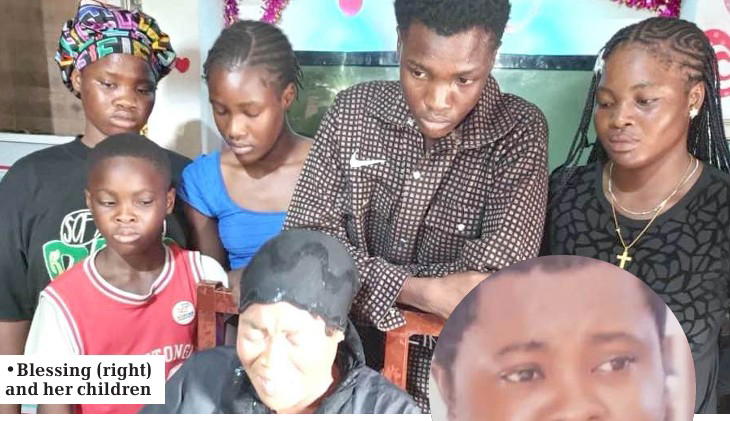
For his widow, Blessing, the events of that Friday evening replay in fragments she cannot escape.
“I watched him struggle,” she said, her voice breaking under the weight of loss. “I begged them to help me take him to the hospital… nobody listened.”
Her account is one of pain and conviction. She believes her husband was deliberately attacked, beaten, she alleges, by suspected land grabbers in a dispute that had cast a shadow over their lives for months. According to her, threats had become a grim routine after her husband acquired a parcel of land now at the heart of the crisis.
But beyond her grief lies a deeper fear: that his death may become just another unresolved story.
Those who knew Nwachukwu describe a man devoted to his family and his work. A father of six, he was said to be in his shop when chaos erupted nearby, an altercation that would spiral beyond control.
Eyewitnesses recount a different sequence of events, one that paints a picture of confusion rather than premeditation. A fight had broken out across the road, drawing a crowd. Then came a man known in the area as “Olopa,” who allegedly claimed to be a police officer and began assaulting people, escalating tensions.
In the middle of it all, Nwachukwu reportedly stepped forward, not to fight, but to restore calm.
“He only asked them to take the fight away from his shop,” said a resident.
Moments later, in the chaos, he was pushed. He fell. His head struck the tiled floor.
What should have been a rescue turned into a race against time that was never won.
News of the incident spread quickly. Calls were made. A frantic journey to the hospital followed.
Mr. Innocent Ogoke, President of Attutarie, recalls the moment reality set in.
“I rushed to the hospital,” he said. “When I got there, I saw him lying lifeless in the car. That was when it became real, he was gone.”
At the scene, remnants of the clash told their own story, broken bottles, scattered debris, signs of a confrontation that had spiralled out of control.
Yet for many, the question remains: could he have been saved?
Some residents believe delays in getting urgent medical attention worsened his condition. Others insist the violence itself was too severe. Between these accounts lies a painful uncertainty that continues to haunt those who witnessed it.
A community unsettled
In the aftermath, tension has rippled through Ijagemo, particularly among Igbo residents who say the incident reflects a broader pattern of intimidation.
“This is not an isolated case,” said Dr. Anthony Nwaeze Onyiyechukwu-Kachukwu, the Obi of Ijagemo. “There have been repeated threats. Our people are living in fear.”
He also revealed that the deceased’s son was injured during the incident and remains hospitalised, adding another layer of anguish for the family.
For many residents, the tragedy has become more than a single incident—it is now a symbol of unresolved tensions around land ownership, identity, and safety.
Holding the line for peace
Amid rising anger, community leaders moved swiftly to prevent further escalation.
Eze Chika Nwokedi, Chairman of the Council of HRM, said he was alerted by the Divisional Police Officer in Ijegun over fears of unrest.
“I was told some people were mobilising,” he said. “We came immediately to calm the situation and appeal for restraint.”
Their intervention may have prevented a deeper crisis, but it has not eased the demand for justice.
The search for answers
Police sources confirm that at least three suspects have been arrested, with one currently in custody at Isheri Police Station. However, questions remain, particularly around the identity of the man known as “Olopa,” and whether he is truly a police officer.
As of now, the Lagos State Police Command has yet to issue an official statement, leaving a vacuum filled by speculation, grief, and growing calls for transparency.
For the Nwachukwu family, justice is not an abstract demand, it is a necessity.
A friend of the deceased, Emmanuel Ejiogu, described him as a peace-loving man caught in violence that was never his.
“He was not part of the fight,” he said. “He was just there, in his shop.”
Back in the family home, where six children now face an uncertain future without their father, Blessing’s grief has hardened into determination.
She is not just mourning her husband, she is fighting for his story to be heard, for accountability, and for a system she hopes will not fail them.
Around her, a community watches closely, waiting to see whether this death will mark a turning point, or fade into silence.
For now, the shop where it all happened stands as a stark reminder: of how quickly life can be interrupted, and how deeply justice is needed when it is.