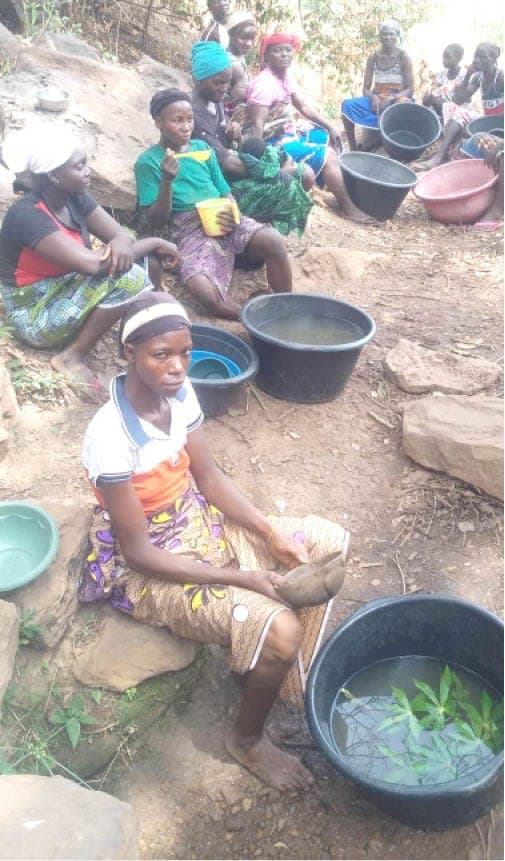
Residents of Tika community in Rubochi ward of Kuje Area Council in the Federal Capital Territory (FCT) have decried acute water scarcity and the absence of a functional health centre, describing both as long-standing challenges affecting their daily lives.
Some residents who spoke when Abuja Metro visited the community on Tuesday said lack of access to potable water has remained their most pressing concern over the years.
They explained that the only reliable source of water is a nearby stream, which dries up during the dry season, leaving households struggling to meet basic needs.
Although a solar-powered borehole exists in the community, residents said it hardly supplies water for up to 20 minutes, making it insufficient for the growing population.
A housewife, Mrs Asabe Danjuma, said she wakes up as early as 4am to trek to the stream, where she digs through sand before accessing water.
According to her, she often waits between 40 and 45 minutes for water to collect before scooping it with a calabash.
“And sometimes before I arrive at the stream, I would meet a large number of other women already on queue with their basins, waiting for their turn to fetch water. This shows how much we are suffering from lack of water in this community,” she said.
Another resident, Mrs Rebecca Ayuba, said the situation is worsened by the fact that villagers share the same water source with cattle.
She explained that after women leave the stream, herders bring their cows to drink from it once water has accumulated.
According to her, she often uses alum to purify the murky water for cooking, drinking and washing.
She added that in some cases, her husband is forced to travel to Rubochi on a motorcycle to buy water from commercial boreholes, especially during special occasions.
“Like two weeks ago, when we had a wedding in my house, my husband had to carry jerrycans on his bike to Rubochi to buy water for our guests,” she said.
The village head, Chief Yakwo Beture Awyekwo, also lamented the situation, describing lack of potable water as a decades-old problem for the community.
He said the community’s only solar borehole is unreliable, as residents sometimes wait for nearly an hour without getting sufficient water before the supply stops.
“Even the solar borehole does not supply regularly. Women can wait for nearly one hour and still not fetch enough water before it stops flowing,” he said.
He added that since the community was established over 100 years ago, access to water has remained a major challenge, noting that local wells have long dried up.
The chief attributed the worsening situation to population growth, including the influx of pastoralists, and appealed to the council authorities to provide a motorised borehole.
He also decried the absence of a primary health centre in the community, saying residents, including pregnant women, are forced to travel to the General Hospital in Rubochi for medical care.
He called on the council to establish a health facility to ease the burden on residents seeking healthcare services.
Meanwhile, an official in the Kuje Area council’s health department, who is also a close aide to the council chairman, Isaac Musa, said the council had made provisions in its budget to drill boreholes in several communities, including Tika.
He added that the works department had also been directed to identify a suitable site for the construction of a clinic in the community, noting that the project has also been captured in the council’s budget.