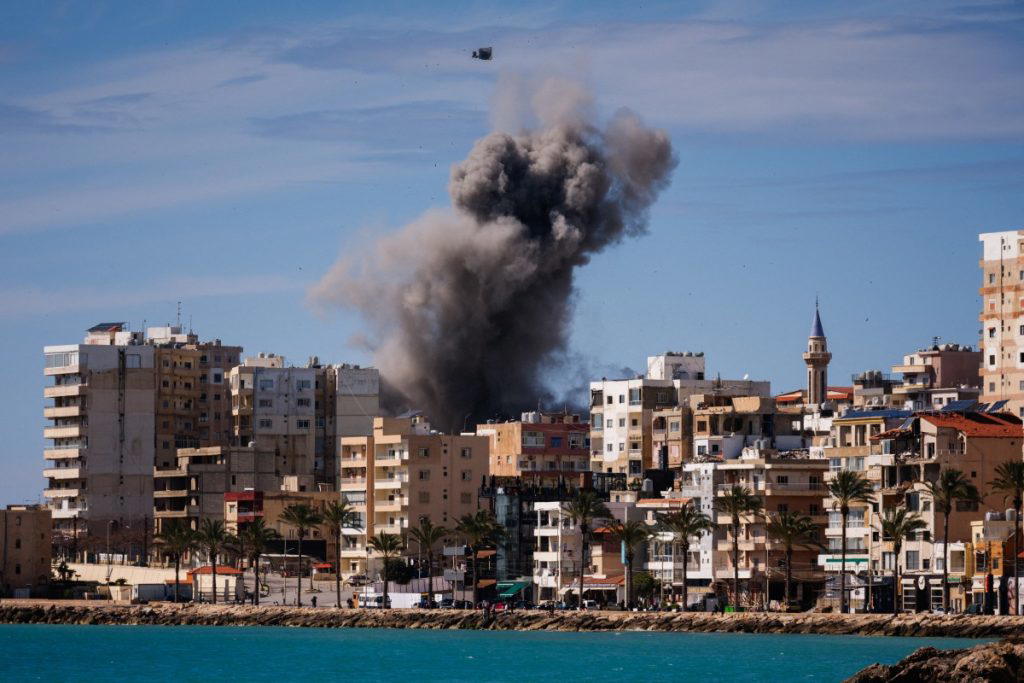
Iran and Israel traded fresh missile and drone strikes Wednesday, with countries across the Middle East coming under fire as diplomats worked in the background to end the nearly four-week war.
The conflict that began on February 28 with US-Israeli attacks on Iran has mushroomed throughout the region, sending world energy markets into tailspin and threatening to torpedo the global economy.
US President Donald Trump signalled talks were underway, with a 15-point peace plan reportedly sent to Tehran, but an Iranian official slapped this down, saying no negotiations had taken place.
With the official status of talks uncertain but diplomats indicating mediation was ongoing behind the scenes, the daily salvoes of strikes across the region continued unabated.
Iran fired a volley of “precision-guided” missiles and drones at Israel and bases hosting US forces in Kuwait, Jordan and Bahrain, the country’s Revolutionary Guards said early Wednesday.
AFP images captured rocket trails streaming over the skies of Israeli coastal city Netanya, as air raid sirens blasted across much of the country’s central region.
Drones hit a fuel tank at Kuwait International Airport sparking a fireball, while authorities in Jordan reported shrapnel falling near the capital Amman and air raid warnings rang out in Bahrain.
Iran has lashed out at Gulf nations, long seen as a relative safe haven in a volatile region, hammering the tourism industry and crippling global air travel as their major hubs come under attack.
The war has also drawn in Lebanon, with Israeli forces aiming to take control of ground up to the Litani River, around 30 kilometres (20 miles) from the border, stepping up its campaign against Iran-backed Hezbollah.
In the Lebanese town of Sahel Alma, north of Beirut, AFP images showed shattered windows and rubble lining the streets after an explosion.
“We have two-year-old children scared and crying and going through this,” local resident Gaia Khouiri told AFP.
The Israeli campaign has killed at least 1,072 people in Lebanon, with more than one million people displaced, according to Lebanese authorities.
Israeli warplanes pounded Beirut’s southern suburbs, a Hezbollah stronghold, again overnight.
An AFP correspondent saw a street covered in debris including shattered cement and and warped pieces of metal after the early morning strike, while an apartment building’s upper floors appeared badly hit.
Israel also said it was launching fresh missile strikes on the “infrastructure of the Iranian terror regime”.
Shayan, a 40-year-woman living in Tehran, told AFP: “There is gasoline, water, and electricity. But there is a sense of helplessness in all of us. We don’t know what to do and there’s really nothing we can do.”
In Geneva, United Nations rights chief Volker Turk warned that strikes around Iran and Israel’s nuclear sites risked unleashing an “unmitigated catastrophe.”
As the fighting on the ground showed little sign of respite, Trump appeared to be ramping up efforts to end the conflict.
The US president, whose daily statements on the war have swung wildly from threatening to conciliatory, said Washington was “in negotiations right now” with Tehran.
He told reporters in the Oval Office that Iran had given him “a very big present worth a tremendous amount of money”, which he said demonstrated that “we’re dealing with the right people”.
Trump did not elaborate further but said it related to the Strait of Hormuz, which Iran has largely blockaded in retaliation for US and Israeli strikes, sending global energy prices soaring.
Several media reported Trump had sent a 15-point plan to Iran via Pakistan, which has offered to mediate a possible end to the war.
But Iran’s ambassador to Pakistan, Reza Amiri Moghadam, said that “contrary to Trump’s claims — so far no negotiations, direct or indirect, have taken place between the two countries.”
The Javan newspaper in Iran splashed a caricature of Trump with a “Pinocchio”-style nose, under the headline: “The world’s most failed and disgraced liar.”
One diplomatic source in the region however said mediators were shuffling messages between the two sides, who were both open to negotiation.
“There is hope but it’s too early to be optimistic,” said this source, who requested anonymity to discuss sensitive issues.
Both sides need to be able to climb down without losing face, this source noted.
In public, Iran kept up its belligerent rhetoric, with the speaker of Iran’s parliament, Mohammad Bagher Ghalibaf, warning the US: “Do not test our resolve to defend our land.”
Focus remained on the strategic Strait of Hormuz, the key route through which one fifth of the world’s crude oil flows.
Tehran, in a message circulated by the International Maritime Organization (IMO), assured safe passage through the strait to “non-hostile vessels”.
However, the IMO cited a statement from Iran’s foreign ministry as saying no passage would be granted to vessels belonging to “the aggressor parties — namely the United States and the Israeli regime”.
The economic impact of the crisis has begun to bite around the world, with governments looking to cut energy consumption and airlines scaling back flights.
But Iran’s pledge, plus Trump’s more conciliatory tone, pushed stocks higher and sent oil prices lower in Asian trade.