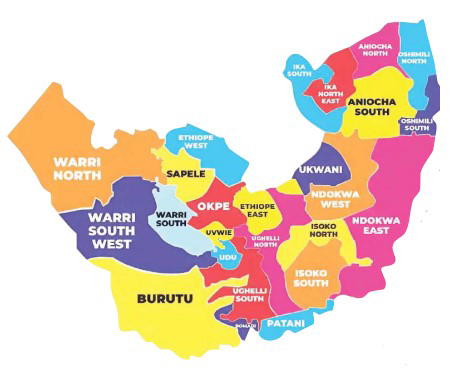
Ughelli South Local Government Area, Delta State, should have been basking in euphoria as the Independent National Electoral Commission (INEC) restored suppressed state constituencies.
Of the 22 restored seats announced on 10 June by the Commission, alongside Benue, Jigawa and Kogi, Delta got six seats back: Aniocha North II, Ika North East II, Sapele II, Ethiope West II, Warri South West II, and Warri North II. “Democracy is expanding,” INEC said.
Painfully, in Ughelli South LGA, no drums were rolled out. Constituents were left with one bitter question: “If INEC can obey 2026 court orders in days, why has it ignored a 2015 Court of Appeal judgment bearing our name for 11 years?”
Ughelli South II was not on the list for restoration. Yet a decade earlier, the locality had won the same legal battle on the same grounds that compelled INEC to restore other seats. That is the wound. The intrigue.
Before 1996, like Isoko North, Ughelli South LGA had two voices in the Delta State House of Assembly (DTHA): Ughelli South I and II. Each brought projects and oversight closer to communities.
In 1999, INEC merged them. “Constituency I” was suppressed in a national “delimitation exercise.” Bureaucratic language. Brutal effect: Ughelli South went from two representations to one.
When Both Constituencies Functioned
Ughelli South had been structured and recognised as two distinct state constituencies. Social justice advocate, Zik Gbemre, captured the timelines from post-independence democracy through the Third Republic.
First Republic: At the creation of the Midwest Region, modern-day Ughelli South maintained two constituencies.
Chief Patrick K. Tabiowo (from Otokutu, Ughievwen Bloc) represented Ughelli South I, emerging as the first Speaker of the Midwestern House of Assembly, while a second lawmaker represented the joint Ewu, Okparabe, Arhavwarien, Effurun-Otor and Olomu bloc.
Under President Shehu Shagari, the dual-constituency structure was preserved. Sir Harrison Jefia (from Ughevwughe, Ughievwen Bloc) was elected to represent Ughelli South I. Chief Sylvanus Omaruaye (from Ewu clan) was elected into the Ughelli South II seat, serving until the military coup in late 1983.
Third Republic (1991–1993):
Following the creation of Delta State, under Olorogun Felix Ibru as governor, the 1st Delta Assembly was inaugurated on 30 January 1992. Ughelli South maintained its two seats.
Hon. Wilson Jighwu (from Usiefrun, Ughievwen Bloc) represented Ughelli South I. Hon. George Dogood Mokpo (from Gbaragolor, Ewu clan) represented Ughelli South II.
At the activation of the Fourth Republic on 29 May 1999, INEC froze Ughelli South Constituency I. For 15 years, the LGA had one representative for its population of over 150,000 – estimated at 315,284 today.
The area is home to oil-bearing towns and dozens of communities. The merger was convenient for INEC. It was never legal.
Patience broke for the people on 12 May 2014. Chief Godwin Sito and five others sued INEC at the Federal High Court, Warri, in suit FHC/WR/CS/59/2014. Their prayer: “Restore what INEC illegally took away.”
On 31 October 2014, Justice Mohammed Shitu Abubakar delivered judgment. His language cut through bureaucracy: “The Defendant does not have any power and/or discretion whatsoever to suppress the existing Ughelli South Constituency I with constituency code No. SC/33/DT in the Delta State House of Assembly lawfully created and approved by the National Assembly.”
The court didn’t suggest. It ordered: “Restore forthwith” Ughelli South I. Conduct a by-election. Stop denying citizens their constitutional right.
On 28 May 2015, the Court of Appeal, Benin Division, ruled on the Commission’s appeal. Justice H. Barka led the panel’s verdict: INEC’s appeal was dismissed “for lack of merit in its entirety.” Barka reminded INEC of history: “The constituency had existed separately before 1996.”
Reaction was swift from Olorogun Taleb Tebite (late), then member-elect for the merged constituency. He said the judgment was “emphatic and clear. It reaffirmed our strong belief in God and the nation’s judiciary.” Eleven years later, he remains the sole representative for the entire LGA.
When INEC still stalled, plaintiffs served Form 48 and Form 49 — notice of consequence of disobedience. Contempt proceedings followed against then INEC Chairman Prof. Attahiru Jega. Court papers warned: “Unless you obey… you will be guilty of contempt of court and will be liable to be committed to prison.”
INEC climbed to the Supreme Court. In 2017, the apex court in _INEC v. Chief Godwin Enasito_ affirmed the earlier judgments of the Federal High Court in Warri and the Court of Appeal, Benin. Three courts, one conclusion: INEC acted illegally in 1999. Restore the seat. Yet today, Ughelli South II is still missing from INEC’s register.
On 10 June 2026, INEC National Commissioner Mohammed Kudu Haruna stated, “The Commission has restored State Constituencies… following judgments of the courts directing that certain constituencies be brought back into the electoral map.”
For Delta, six seats “previously suppressed” were restored by “recent court judgments.” Party primaries were fixed for 16–25 June 2026. Fresh delineation. New voters.
The crux is Ughelli South’s absence from the list. INEC obeyed 2026 court orders within days. But it has not obeyed 2015 orders after 11 years. Both orders concerned suppressed constituencies. What changed?
Why the selective obedience by INEC? Is there an expiry date on justice? The Commission’s statement cited “powers conferred by the 1999 Constitution and Electoral Act 2026.” The same powers existed in 2015. Section 287(1) says “all authorities… shall obey” court decisions. No time limit.
So why did INEC obey the Warri South West II judgment from 2024 but not Ughelli South I from 2015? “When INEC obeys a 2024 judgment and ignores a 2015 one, it sends a message: justice is only justice if it’s fresh,” a senior lawyer observed.
Warri got attention, Ughelli got silence. INEC’s 2026 restoration coincided with the final “Warri delineation report.” There is a thinking that INEC prioritized Warri in response to years of ethnic conflicts, protests, and media pressure.
Ughelli South had no protests. Just a quiet court judgment. A Delta Assembly source said: “Crisis gets you a seat. Court judgment alone does not. That’s the lesson Ughelli South has learned.”
In the numbers game, restoring Ughelli South II plus Isoko North II would take the Delta Assembly from 29 to 31 members.
The 2026 restoration kept the Assembly at 29 because the six seats were swaps, not additions. Adding Ughelli South II meant real expansion: more salaries, more offices, more budget.
The 2014 FHC judgment declared the 29-member Assembly “not properly constituted.” INEC ignored that too.
Apparently for administrative convenience, an 11-year-old judgment, for INEC, is “stale.”
Restoring Ughelli South II meant new ward delineation, new polling units, fresh primaries. INEC must redo 1999 work.
An INEC official, speaking off record, admitted, “Old judgments are messy. You have to trace old boundaries, deal with new settlements. Easier to work with recent cases where records are digital.”
“Lame excuse. Administrative difficulty is not a defence in law. Contempt of court doesn’t accept that. Besides, the boundaries were there before suppression. It’s simply to pronounce the same restored,” responded Gbemre
The 2014 court relied on Sections 6, 36, 91 and 112. INEC’s own lawyers conceded the seat was “lawfully created” in 1991. The suppression had no constitutional backing.
It’s one representative, but many voices in Ughelli South LGA speak of constituency development projects that never came. Of wards that feel “too far” from Asaba.
The burden feels heavy on incumbent Hon. Festus Otuama, a single voice speaking for two supposed constituencies today.
“When one man speaks for 30 communities, 15 voices are silent. That was the plan in 1999. The court said stop. INEC refused. Now INEC restores other people’s seats and leaves ours. What do we call that?” a constituent lamented.
Ughelli South could not have lost out in 2026 when it won in 2014. What it lost was implementation. The June 2026 restoration didn’t create new inequality. It exposed impunity.
Extraneous to the law, it proved INEC’s willingness to obey courts depends on timing, politics, and convenience.
Until the Commission gazettes the 2015 Court of Appeal judgment and delineates Ughelli South II, the LGA remains Nigeria’s most latent constituency — existing only in statutes but never captured on election ballots.
A stakeholder summed it up: “INEC will restore seats when courts force it now. When forced much earlier, INEC went to sleep.
“For Ughelli South people, the wait for their second voice sustains. The seat won in court, yet lost on the ground. And the people are still waiting.”
Gbemre added, “Ughelli South is a major hub churning oil and gas wealth that sustains the nation. To marginalise such a critical economic and cultural engine is unacceptable.”
A different set of litigants are said to be pursuing a separate pending legal battle with INEC over the same Ughelli South I suppression.