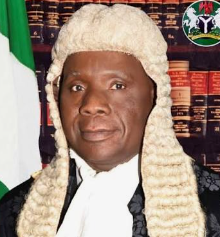
By Ikechukwu Nnochiri
With the nation marking 66 years of independence and 27 years of uninterrupted democratic rule, the intrigues around the military junta’s annulment of the 1993 presidential election have resurfaced in a story narrated by a retiring Supreme Court justiceJustice Ibrahim Saulawa bowed out of active judicial service and exited the Supreme Court bench on September 29, the date he reached the mandatory retirement age of 70.In keeping with tradition, the Supreme Court held a valedictory session in his honour, giving the retiring jurist an opportunity to reflect on his career and speak on matters of national importance.In his speech titled: On the Eve of a Terminal Leave, Justice Saulawa, whose 44-year journey in the legal profession spanned service in court administration and life on the bench, narrated how the military smeared the judiciary in a bid to justify the June 12, 1993 debacle that annulled the election of Chief Moshood Abiola of the Social Democratic Party (SDP).He noted that before the military struck, Abiola, popularly known as MKO, was leading by a wide margin in many northern states, including in the ward of his main challenger, Alhaji Bashir Tofa of the National Republican Convention (NRC).Recalling the crisis precipitated by the military junta’s ill-advised cancellation of the presidential poll, Justice Saulawa said it was unfortunate that the then military leadership claimed it took the action to save “the judiciary from self-destruction”.The jurist said he was then serving as Chief Registrar of the Court of Appeal.He alleged that the military repeatedly tried to infiltrate the judiciary through “forum shopping”, with the efforts manifesting in several conflicting court orders.Going down memory lane, Justice Saulawa said: “On June 10, 1993, Hon. Justice Bassey Ikpeme of the FCT High Court granted an order of injunction, thereby restraining the National Electoral Commission (NEC) from conducting the long-awaited presidential election slated for June 12, 1993.“The suit was instituted by Chief Arthur Nzeribe’s Association for Better Nigeria (ABN). However, Professor Humphrey Nwosu, NEC’s Chairman, ignored the interim order, went ahead and conducted the election as scheduled, banking on powers under Decree 13 of 1993.“On June 15, 1993, the Chief Judge of the FCT High Court, Hon. Justice Dahiru Saleh, granted a second interim order, thereby restraining NEC from further releasing or announcing the results of the election.“While the FCT High Court issued the two interim orders in question, some state high courts joined the fray by issuing counter or conflicting orders, thereby simultaneously directing NEC to continue announcing the results.“Appeals were filed at the Court of Appeal, Kaduna Division, by the NEC.”The Katsina-born jurist said that as the appellate court’s Chief Registrar, he immediately took steps to stem the tide of conflicting court orders which, he said, were orchestrated by the military.Insisting that the legal confusion was the handiwork of the military junta, Justice Saulawa said he acted on the directive of the then President of the Court of Appeal (PCA), Justice M. Akanbi, by swiftly moving to Kaduna to take control of the appellate court’s registry.“As the Chief Registrar of the Court of Appeal, and the only spokesperson thereof, I flew from Lagos to Kaduna and took effective control of the Registry and supervised the registering of the appeals and the issuing of the appropriate court processes to the respective parties to the appeals.“I equally issued a press release regarding the circumstances surrounding the two appeals and motions relating thereto.“Later in the evening, I flew back to Lagos and briefed the PCA, Hon. Justice MMA Akanbi, a man of unquestionable integrity and unwavering courage.Upon my advice, the Hon. PCA called for an emergency meeting of the Hon. Presiding Justices over the crisis.”He said it was after every effort the military made to permeate the judiciary “was frustrated by myself and Justice Akanbi” that the then Head of State, General Ibrahim Babangida (IBB), annulled the election.“On June 23, 1993, the Federal Military Government purportedly issued a statement (unsigned) circulated by Nduka Irabor, thereby annulling the June 12, 1993 Presidential Election.“It is trite that the annulment of the June 12, 1993 Presidential Election plunged Nigeria into profound civil unrest and a devastating political crisis.“General IBB was forced to dramatically ‘step aside’ and relinquish the reins of power to the contrived, shortened Interim National Government (ING), headed by Chief Shonekan.“Not surprisingly, the ING was in due course toppled in a palace coup d’état in November 1993 by General Sani Abacha, General IBB’s CDS and Minister of Defence.“For declaring himself President in 1994, Chief Abiola got himself stuck on the horns of a dilemma. He was arrested and detained by General Abacha.Unfortunately, he remained in detention until his death in July 1998.“Undoubtedly, the crucial role played by the judiciary, most especially the Supreme Court and the Court of Appeal, in stemming the tide of the June 12, 1993 crisis can never be over-emphasised.“We actually did all we could do to frustrate the military,” added the retiring jurist, whom the Chief Justice of Nigeria (CJN), Justice Kudirat Kekere-Ekun, described as “a distinguished judicial officer and a man whose life has been defined by service”.Called to the Nigerian Bar on July 2, 1982, Justice Saulawa joined the judiciary in 1983 as a Magistrate Grade II.He steadily rose through the ranks, serving as Chief Magistrate in the Katsina State Judiciary and later as Deputy Chief Registrar and Chief Registrar of the Court of Appeal in Lagos.In 1994, he was appointed a judge of the High Court of Katsina State, where he served for 12 years before his elevation to the Court of Appeal in 2006.His years at the Court of Appeal took him through several divisions of the court in the country, serving as Presiding Justice in Calabar, Ilorin and Port Harcourt.On November 10, 2020, he was elevated to the Supreme Court, where the CJN said he served with “diligence, learning and fidelity to the judicial oath”.While extolling Justice Saulawa’s virtues, the CJN noted that his long experience enriched the deliberations of the Supreme Court, while his considered approach to adjudication reflected an appreciation of both the law and the human realities that often lie behind the cases brought before the court.“This is an aspect of judicial service that deserves emphasis.The law remains the compass of judicial decision-making, but the administration of justice also demands an appreciation of the human consequences of those decisions.“His Lordship’s long years on the Bench have given him ample opportunity to appreciate this essential dimension of judicial responsibility.“His Lordship’s retirement also provides an opportunity for all of us gathered here to reflect on the meaning of a judicial career. The institutions in which we serve will continue to evolve. The challenges confronting the judiciary will continue to change,” the CJN stated.