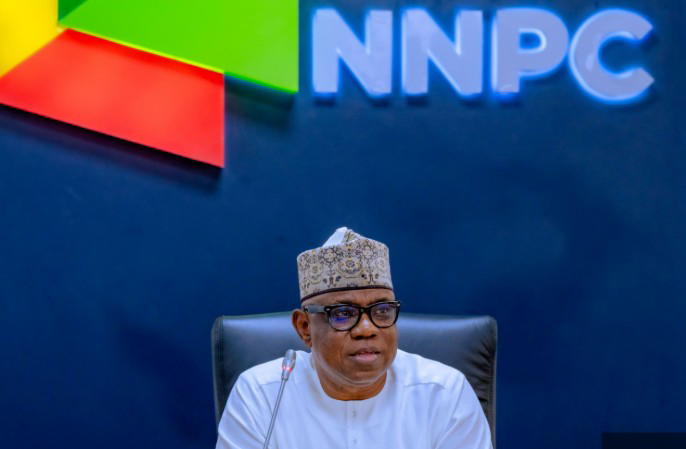
— Nigeria targets global gas opportunities
By Obas Esiedesa, Bangkok
The Nigerian National Petroleum Company Limited (NNPC Ltd) has said it is increasing gas supply to operators in the Compressed Natural Gas (CNG) value chain as part of efforts to cushion Nigerians from the impact of high petrol prices
Executive Vice President, Gas, Power and New Energy, NNPC Ltd, Olalekan Ogunleye, disclosed this in an interview with Vanguard on the sidelines of the 2026 Gas Technology Exhibition and Conference, Gastech, in Bangkok, Thailand, on Monday
Ogunleye said NNPC, working with upstream producers and other stakeholders, was increasing gas supply to the domestic market, with CNG operators receiving particular attention
According to him, the Gas Master Plan, launched on January 30, 2026, was already yielding results, with about 791 million standard cubic feet (scf) of incremental gas supply recorded by the end of August
He said the volume represented 17 per cent of the Federal Government’s target of delivering 46 billion scf of incremental gas between the end of 2025 and 2030.
“The job is on But more importantly, the government and the leadership of NNPC have taken adequate steps to ensure that anyone today that invests in the CNG value chain gets the gas they require,” Ogunleye said.
“The upstream is cooperating The CNG requirements are not humongous. They are manageable.”
He said NNPC was enforcing domestic gas delivery obligations to ensure that investors in CNG stations, mini-LNG plants and other gas-based projects could access the feedstock required for their operations
“The domestic gas delivery obligations are being enforced to make sure that everyone investing in CNG manufacturing stations or mini-LNG gets the gas they require And we’re beginning to see the fruit of that effort,” he said.
Ogunleye said NNPC was also strengthening coordination across the gas value chain to ensure that increased production translated into greater domestic utilisation
He said the expansion of the CNG market had wider economic implications, particularly for transportation and food production, as gas-based transportation could reduce the cost of moving agricultural produce and other goods across the country
Speaking earlier during a panel session titled, “The New LNG Order: Leadership Strategies for Energy Security and Growth,” Ogunleye said reliable gas supply and deliverability were critical to attracting investment into Nigeria’s gas industry
He warned that proposed projects could struggle if key fundamentals, particularly reliable gas supply, were not established from the outset
“For us in Nigeria, our alignment is, it’s not just enough to learn, but we have to showcase learning going forward to make sure that there’s consistent focus on gas development, deliverability,” he said
Ogunleye also identified financing and partner selection as key requirements for successful gas projects, urging developers to work with financial institutions that understand the African market and can navigate its investment risks
He said investors should also select partners with shared ambitions and the capacity to co-develop projects
According to him, Nigeria must pursue both domestic gas utilisation and exports, stressing that the two should not be viewed as competing priorities
“It’s a false choice to think that there’s a competition between domestic and export,” he said
Ogunleye explained that NNPC’s gas business had a dual mandate of generating foreign exchange through exports while using gas to support industrial development and strengthen domestic energy security
He said LNG remained important for incentivising further gas development and creating value, but Nigeria must simultaneously develop an integrated domestic gas value chain
Ogunleye said Nigeria was leveraging its more than 215 trillion cubic feet (tcf) of proven gas reserves to drive industrialisation and strengthen its position in the global gas market
He said the Gas Master Plan was designed as a “gap-to-potential tool” aimed at moving the country from its current reserve position towards more than 600 tcf, while increasing national gas production to 10 billion standard cubic feet per day (Bscf/d) by 2027 and 12 Bscf/d by 2030
He noted that Nigeria’s LNG infrastructure had already established the country as a major global supplier, with Trains 1-6 producing 22 million tonnes per annum, while Train 7 is expected to be completed in 2027
Ogunleye said Nigeria’s strategic location between the Atlantic Basin and Asian markets, its gas reserves and evolving regulatory framework provided a basis for expanding both domestic utilisation and exports
Nigeria targets global gas opportunities
The Minister of State for Petroleum Resources (Gas), Ekperikpe Ekpo, had earlier assured international gas consumers of Nigeria’s readiness to increase production and exports amid disruptions to global energy supplies arising from the blockage of the Strait of Hormuz
Ekpo gave the assurance at the conference, saying the Federal Government was taking steps to expand gas production, develop infrastructure and position Nigeria to meet rising domestic, regional and international demand
He said the administration of President Bola Tinubu had created a more conducive environment for investment in the gas sector through executive orders supporting implementation of the Petroleum Industry Act (PIA)
The minister, however, said Nigeria’s vast gas reserves alone would not be sufficient to take advantage of opportunities created by disruptions in global energy supplies
“Resources alone without provision of infrastructure, technology and financing cannot take us anywhere,” Ekpo said
According to him, the government was supporting investment in gas infrastructure, including through the gas infrastructure fund provided for under the PIA, to facilitate the transportation of produced gas to markets across Nigeria and beyond
Ekpo said Nigeria was already supplying gas to countries in the region, including Ghana and Togo, while pursuing additional export opportunities
“We are engaging with the Trans-Saharan Gas Pipeline to supply gas to Morocco, which ultimately will get to the international market We are in negotiation with Algeria and Equatorial Guinea,” he said.
He identified the OB3 and Ajaokuta-Kaduna-Kano (AKK) gas pipelines as critical infrastructure being developed to connect gas-producing areas with markets across the country
He said the projects would strengthen domestic supply while providing infrastructure to support regional exports
Ekpo also pointed to the Decade of Gas initiative, launched in 2021, which he said had identified about 20 projects expected to increase gas production sufficiently to meet domestic and regional demand, with surplus volumes available for export
“We are progressing to catch up with the demands of our country and, of course, with the regional demands,” he said
The minister stressed that domestic consumers would remain the priority, noting that the government had established a domestic delivery obligation requiring producers to meet local demand before exporting surplus gas
He added that tax waivers had been granted for gas-related equipment as part of measures to encourage investment in the sector
On domestic energy demand, Ekpo said the administration was expanding the use of CNG through the Presidential Initiative on CNG, including the deployment of CNG buses and refuelling stations nationwide
Meanwhile, Oman’s Minister of Energy and Minerals, Salim bin Nasser Al Auh, said the current global energy supply challenge was not caused by a shortage of oil and gas resources or technology, but by difficulties in moving supplies from production centres to consumers
He said the Strait of Hormuz disruption had exposed vulnerabilities in global energy supply chains and underscored the need for countries to diversify export routes and sources of supply
“The resources are there, we know where they are The technology is available to go after these resources. We know how to produce it, how to process it, how to transport it, how to liquefy it and how to get it to the end customer,” he said.
“What we are struggling with is the ability to do the last piece, which is to get it out from where it’s produced, to where it’s needed the most”
Al Auh said the disruption could stabilise in the medium term but urged energy-producing countries to develop alternative routes to reduce their exposure to strategic chokepoints
Speaking at the opening ceremony, Thailand’s Prime Minister, Anutin Charnvirakul, warned that disruptions to global energy supplies were increasing household expenses
He said the high cost of energy was unsustainable and called for increased investment in the sector
Charnvirakul said an energy transition that “keeps people unable to pay their bills is unacceptable”