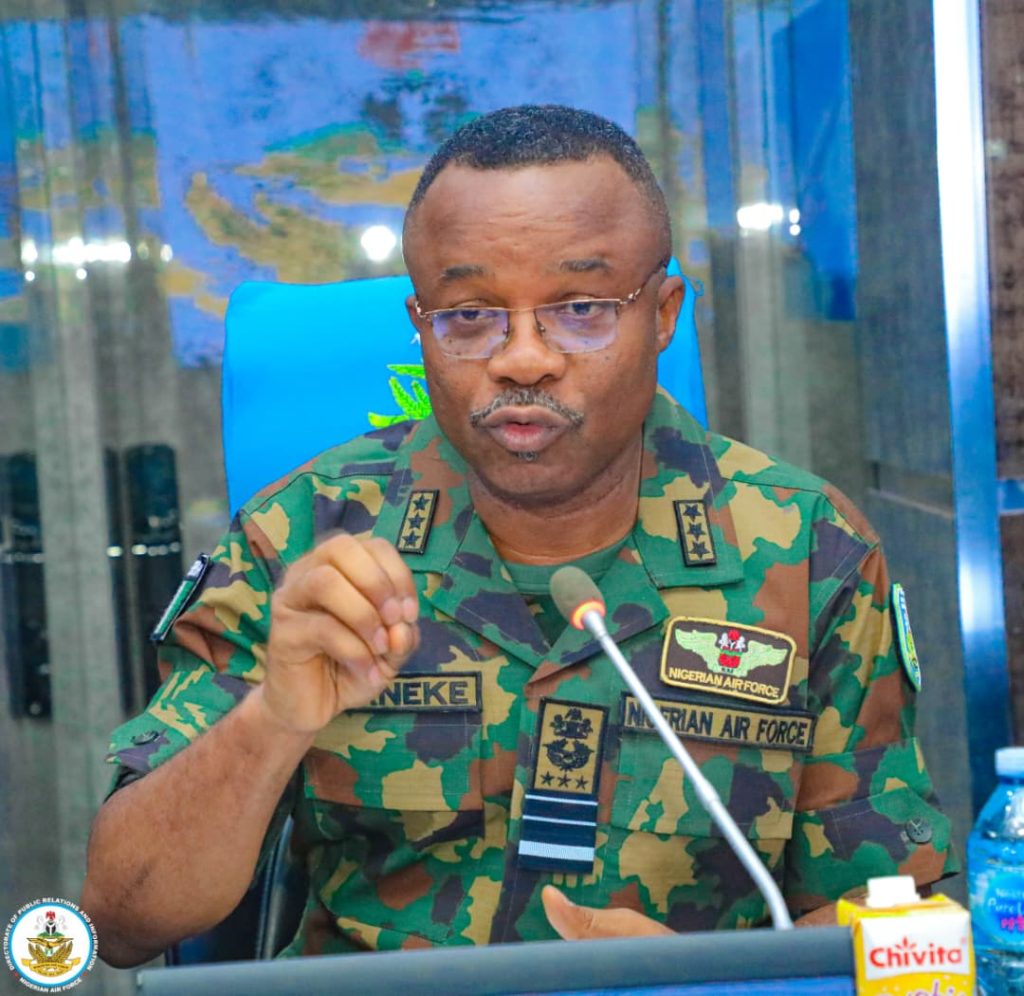
As the Nigerian Air Force (NAF) continues to strengthen its operational capabilities in response to evolving security challenges, a defining priority under the leadership of the Chief of the Air Staff (CAS), Air Marshal Sunday Kelvin Aneke, is to build a force that not only acquires modern platforms but also develops the technical expertise, maintenance capacity and indigenous innovation required to sustain them As the CAS marks his first year in office on 30 October 2026, this commitment reflects a broader vision of an operationally effective, technologically capable and increasingly self-reliant Air Force. For the NAF, modernisation goes beyond the procurement of aircraft and equipment. It encompasses the development of skilled personnel, the strengthening of maintenance systems, the adoption of emerging technologies, the improvement of infrastructure and the progressive development of indigenous solutions. These priorities are critical to ensuring that the Service remains responsive to Nigeria’s security needs while building the institutional resilience required to sustain airpower over the long term.
Renewing the Platforms of Airpower
The modernisation of the NAF Order of Battle remains one of the key drivers of the CAS’s command philosophy In this regard, the Service has continued to pursue the acquisition and introduction of platforms designed to strengthen its operational flexibility and mission effectiveness. Its September 2026 anniversary update recorded the delivery of five additional helicopters comprising three AW-109 Trekker Type B helicopters and two H125 helicopters.
The NAF has also pursued programmes involving 12 AH-1Z attack helicopters and six M-346 aircraft While the AH-1Z programme is intended to enhance combat capability and close air support for surface forces, the M-346 programme is expected to strengthen advanced pilot training and provide light-attack capability. Together with other platforms in the NAF inventory, these acquisitions are intended to support a balanced force capable of undertaking diverse operational assignments.
However, the NAF recognises that acquiring modern aircraft is only one part of the capability equation Effective employment requires trained aircrew, qualified engineers and technicians, dependable logistics, appropriate maintenance facilities and sustained technical support. Accordingly, platform modernisation must go hand in hand with investments in the people, systems and infrastructure that keep aircraft mission-ready.
Advancing Indigenous Innovation
A significant dimension of the NAF’s transformation agenda is the development of indigenous technical capacity While sophisticated aviation systems will continue to require international partnerships and specialised support, expanding local production and engineering competence can reduce selected supply-chain vulnerabilities, strengthen sustainment options and create opportunities for Nigerian technical personnel.
In pursuit of this objective, the NAF has reported the local production of Aircraft Release Device 863 impulse release cartridges by 633 Central Armament Depot to support the sustainment of the A-29 Super Tucano fleet Similarly, 109 Composite Group has manufactured a 250-kilogram bomb-loading trolley intended to enhance the safety and efficiency of weapons-loading operations.
These initiatives demonstrate the practical value of developing solutions to specific operational and maintenance requirements within the Service Beyond the immediate equipment produced, they provide opportunities to strengthen technical skills in fabrication, engineering, testing and quality assurance. The emphasis remains on ensuring that locally developed equipment meets the applicable technical, safety and performance standards required for military aviation operations.
Developing Homegrown Technical Solutions
Another notable initiative outlined in the CAS’s early leadership memorandum is the local design and production of a 57-millimetre rocket According to the memorandum, more than 10 rockets had been produced locally, with six expended during ground tests conducted at the NASRDA Range in Kachia, Kaduna State, on 15 and 29 December 2025.
The initiative reflects the NAF’s determination to expand its indigenous engineering capacity and deepen local participation in the development of defence-related technologies Further progress will depend on continued testing, engineering validation, quality assurance and compliance with the applicable qualification and safety requirements.
The wider significance of such initiatives lies in their potential to strengthen the relationship between operational requirements, military engineering expertise, research institutions and domestic industry By progressively developing these capabilities, the NAF is contributing to a foundation for greater technical self-reliance while recognising that dependable defence production requires sustained investment, rigorous testing and institutional oversight.
Sustaining Capability Through Effective Maintenance
The operational value of an aircraft depends not only on its performance but also on its availability, reliability and safety throughout its service life For this reason, the CAS’s emphasis on predictive maintenance, maintenance quality assurance and timely logistics support remains integral to the NAF’s modernisation efforts.
Recent maintenance activities reported by the Service include the reactivation of a Super Puma helicopter, the completion of a 600-hour inspection on Dornier-228 aircraft NAF 039 and the commencement of overhaul work on C-130H aircraft NAF 913 at OGMA facilities in Portugal These efforts underscore the importance of sustaining existing platforms alongside the introduction of new capabilities. The NAF continues to recognise the need for sound technical records, effective maintenance planning, timely replacement of components and strict adherence to approved procedures. These measures are essential to reducing avoidable downtime, improving resource utilisation and supporting safe, reliable aircraft operations. Ultimately, the objective is not merely to return aircraft to service but to ensure that they meet the required airworthiness and operational standards.
Leveraging Technology-driven Operations
The drive towards technological capability also extends to intelligence, surveillance, information analysis and operational decision-making As security threats evolve, the ability to collect, assess and integrate relevant information is increasingly important to the effective employment of airpower.
In line with the CAS’s command philosophy, the NAF has identified intelligence-driven smart operations and the adoption of advanced technologies as important enablers of operational effectiveness The planned Open-Source Intelligence Centre within the Air Intelligence Branch is intended to improve the exploitation of publicly available information in support of situational awareness and operational planning.
Similarly, investment in unmanned aerial vehicle training reflects the growing relevance of emerging technologies to contemporary air operations Such capabilities can support surveillance and information gathering within the limits of available systems and authorised operational roles. Nevertheless, technology alone does not guarantee operational success. Its effectiveness depends on the competence of personnel, the reliability of supporting systems, sound analytical processes and compliance with established operational and safety standards. The NAF’s approach therefore combines technological advancement with professional judgement, accountability and disciplined execution.
Infrastructure and Personnel as Capability Multipliers
Modern platforms and sophisticated systems require appropriate infrastructure and a skilled workforce to deliver their full operational value Recognising this, the NAF has continued to invest in facilities and supporting infrastructure to strengthen operational effectiveness and improve the working and living conditions of its personnel.
The Service’s first-anniversary update recorded 284 approved infrastructure projects, comprising 145 completed projects and 139 ongoing projects at the time covered by the update These projects include improvements to accommodation, operational facilities, roads, power supply, water and other essential infrastructure.
Such investments are central to creating an enabling environment for personnel to perform their duties effectively Hangars, maintenance areas, airfield facilities and reliable utilities support aircraft sustainment, while improved accommodation and welfare facilities contribute to personnel motivation and institutional effectiveness.
The NAF remains focused on ensuring that infrastructure development is aligned with operational priorities, delivered to the required standards and sustained through appropriate maintenance Equally important is the continuous development of personnel whose technical competence, professionalism and dedication remain indispensable to the effective employment of airpower.
Building a More Resilient Air Force
As Air Marshal Sunday Kelvin Aneke marks his first year as Chief of the Air Staff, the NAF’s modernisation efforts reflect a connected strategy built around platform renewal, indigenous innovation, effective maintenance, technological advancement, infrastructure development and personnel capacity building
The task ahead is to consolidate these gains through sustained investment, rigorous technical standards, effective resource management and strategic partnerships with credible domestic and international organisations This will require continued attention to the full lifecycle costs of aircraft, the availability of technical support, the development of specialised skills and the progressive translation of local innovation into dependable capabilities.
Under the leadership of the CAS, the NAF remains committed to strengthening its ability to operate, maintain and progressively develop the capabilities required to fulfil its constitutional responsibilities The objective is not simply to acquire more advanced equipment but to build a force capable of employing its assets effectively, sustaining them responsibly and adapting to changing operational demands. For the Nigerian Air Force, the journey from acquisition to innovation is therefore a strategic investment in operational readiness and national defence resilience. By combining modern platforms with indigenous technical expertise, disciplined maintenance, advanced technologies and capable personnel, the Service is working towards a more sustainable airpower capability for Nigeria today and in the years ahead.
*Air Commodore Ejodame is Director of Public Relations and Information, Nigerian Air Force