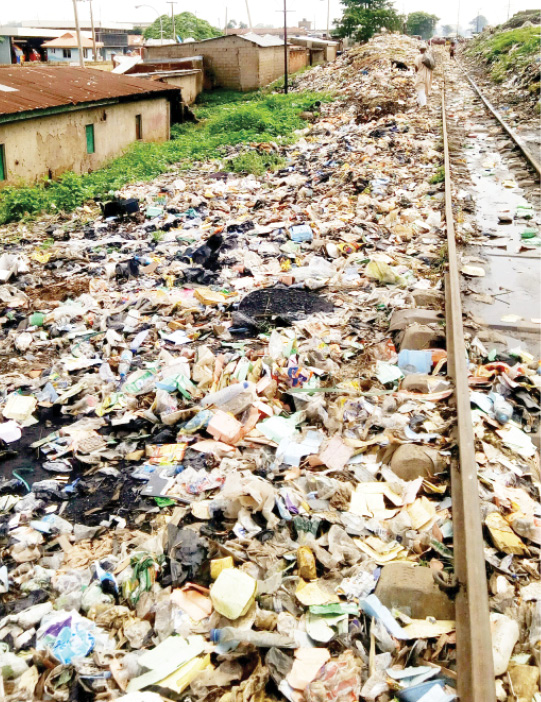
Following the prediction by the Nigerian Meteorological Agency that 33 states and the Federal Capital Territory (FCT) may experience heavy flooding this rainy season, residents of Abuja, particularly those in satellite towns have raised concerns over blocked drainages in their communities.
Many residents who spoke to Abuja Metro yesterday said the flood alert has drawn renewed attention to the poor state of drainage channels across streets in Gwagwalada, Kuje and other parts of the territory.
They called on the FCT Minister, Nyesom Wike, to direct area council chairmen to urgently clear refuse blocking drainages to avert possible flooding.
In Gwagwalada, Mr. Ephraim Felix said the area is at risk due to heaps of waste clogging drainage channels within the town.
He also expressed concern over indiscriminate dumping of refuse along the Abuja–Lokoja highway, warning that it could worsen flooding and disrupt traffic if urgent actions are not taken to clear them.
“If you go round some streets in Gwagwalada, you will see that drainages, especially those built along new roads, are almost taken over by refuse,” he said. “The same thing is happening along the highway.”
He urged stakeholders to work with council authorities to ensure immediate evacuation of waste from drainage channels.
In Kuje, another resident, Michael Abraham, said the flood warning should not be ignored, noting that several streets—particularly around the mini stadium axis—already have blocked drainages.
He recalled recent flooding incidents that left motorists stranded, including the collapse of a bridge linking Kuje and Gwagwalada.
“We saw what happened two weeks ago when a bridge collapsed due to heavy flooding and people were stranded,” he said.
Abraham called for stronger environmental enforcement and regular sanitation exercises, adding that residents must also stop dumping waste into drainages.
An environmental expert, Sunday Ajayi, described the flood alert as a warning signal that requires urgent preventive action, especially in flood-prone communities.
He blamed indiscriminate waste disposal by residents and traders, and urged area councils to intensify drainage clearing and waste management operations.
Ajayi also called for closer collaboration between the FCT Administration and area councils, stressing that contractors handling sanitation projects should be mobilised to begin immediate evacuation of refuse.
In Gwagwalada, an official of the environmental department, Mr. Danjuma Ibrahim, said drainage clearance has largely remained under the responsibility of the FCT Administration, though councils continue periodic sanitation efforts.
He said the council is working on strengthening enforcement through an environmental task force to curb indiscriminate dumping of waste.
Similarly, in Kwali Area Council, an environmental official, Mr. Bawa Emmanuel, said the council has introduced waste bins across communities and embarked on drainage construction projects to mitigate flooding.
He added that an environmental task force has also been established to enforce sanitation in the area.
FCT emergency department speaks
When contacted yesterday, the Acting Director-General of FCT Emergency Management Department (FEMD), Engr. Abdulrahman Mohammed, said the agency has already commenced preparations to mitigate the potential impact of flooding across Abuja and satellite communities.
According to him, the agency received the flood outlook document and has begun reviewing areas of critical concern within the territory.
“The FCT has a high risk of flooding this year. What we have done is to study the document and identify areas that concern us as a city,” he said.
Mohammed explained that the agency’s response plan includes coordination with stakeholders, continuous monitoring of water levels, and emergency interventions where necessary.
“We will call all stakeholders together, share information and let people know what needs to be done,” he said. “We will also monitor water levels every two to three weeks, and where necessary, we close roads or open them depending on the situation.”
He added that FEMD would also intensify public sensitisation campaigns in flood-prone communities, including possible evacuation of residents where risk levels become severe.
“Those we need to relocate, we will relocate them. Those we need to move to safer locations, we will guide them,” he said.
Reacting to concerns over blocked drainages and indiscriminate dumping of refuse across the FCT, the Acting DG said waste management remains a key responsibility of environmental authorities, while FEMD’s role is largely coordination and emergency response.
“This is why we are calling all stakeholders together. Environmental agencies must clear waste and ensure proper disposal. Our job is to monitor flood situations and respond when necessary,” he said.
The agency assured residents that it would intensify surveillance and preparedness efforts in the coming weeks as rainfall increases across the territory.