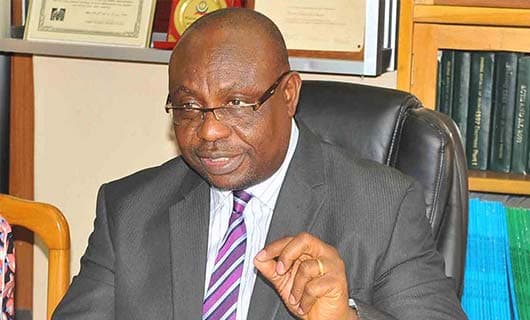
Human rights lawyer and former National Commissioner of INEC, Festus Okoye speaks on the evolution of party leadership, the growing dominance of the executive, and the implications on Nigeria’s democratic development.
How would you assess the current trend in the ruling party where the structure seems to be controlled from outside?
The influence of presidents and governors on their parties did not start with the current regime. Since the return to civilian democratic rule in 1999, various presidents and governors have overseen the rise and fall of party leaders. They have orchestrated the ascents and descents of Senate Presidents, Speakers of the National and State Assemblies, and Chairpersons of their parties at both federal and regional levels. This influence affects all political parties. In some cases, party executives aim to stay in power indefinitely.
In certain instances, any exertion of power by party executives leads to their removal. The parties are funded by public money, and their members are not involved in their management. Instead, the Executive provides funding to the parties, which then give their members stipends to attend rallies. In reality, most existing political parties are at risk of deregistration under section 225A of the Constitution.
What are the consequences of this increasing outside influence on internal party democracy?
Honestly, I cannot confirm that any of the existing political parties operate in accordance with the principles of internal democracy. Some of their leaders have held power for over a decade and have resisted all efforts to organise elections. Certain parties lack proper structure in various electoral wards. Others have fake membership registers, and some have compiled names and cropped pictures from photo studios to serve as their membership lists. In some parties, the governors exert incestuous influence over the parties. The president also wields influence over his own party. This weakens the parties and is not beneficial to our democracy. With the increasing reliance on consensus options, internal democracy has disappeared within the parties.
Does it affect the institutional stability of political parties in Nigeria?
Most political parties still operate from rented offices. The salaries of their workers are funded by the government treasury. When there is a change of government, their prospects change significantly. The tragedy is that party officials are beholden to the ruling government and lack true independence. This has also hampered the parties’ growth.
More broadly, what does this trend mean for Nigeria’s democratic development?
It means that our political parties will not develop or become ideologically grounded. It also indicates that party executives will continue to kowtow to the government in power. Consequently, political parties will remain weak, and the executive will continue to dictate their actions.
Can you give us a historical overview of how party leaderships were in previous Republics (especially the Second Republic)?
During the First and Second Republics, political parties exerted greater influence, and their leadership held stronger control over policies and programmes. The membership of certain parties influenced their leadership, with members joining based on ideological beliefs and the charisma and contributions of leaders to national development. Although ethnicity and religion affected the direction of some parties and their members, the parties maintained substantial authority over their elected representatives.
As Richard Sklar notes, the ideological stance of the parties during the First Republic can be understood in terms of the democracy they supported. The National Council of Nigeria and Cameroon (NCNC) advocated for classical, individualistic political democracy.
The Action Congress of Nigeria promoted federalist democracy to safeguard cultural community rights. The Northern People’s Congress (NPC) embodied the modernisation of traditional authority, while its radical rival, the Northern Elements Progressive Union (NEPU), championed egalitarian democracy. These parties were organised and rooted in their membership. Members carried membership cards and paid for them. Some traveled long distances to attend rallies.
Although the parties of the Second Republic remained strong, they increasingly depended on government funding and support from contractors, consultants, and middlemen, thus losing control over their own parties. The parties’ leadership remained influential and exerted some authority over the executive and legislative branches of government. However, they became more autocratic and grew insensitive to the suffering of the Nigerian people, aiming to stay in power and maintain control by any means necessary.
How will you assess party leadership in the present time across all parties?
The membership registers of some political parties are kept at the government house, and their leadership is determined there. As a result, the parties lack independence. The leaders serve at the discretion of the Governors and the President. The parties are managed according to the wishes of the executive. The executive extends patronage to the parties, which operate from various government houses.
The lack of independence among the parties is also linked to the fact that anyone or any group with limited resources can register a political party. The only essential requirement in section 223 of the Constitution is that an organisation seeking registration must have an office in the Federal Capital Territory, Abuja. This can be a one-room flat in any part of the Federal Capital Territory.
Additionally, it is easily satisfied by a provision that states the constitution and rules of a political party must provide for the periodic election, based on democratic principles, of the main officers and members of the executive committee or other governing body of the political party; and ensure that the members of the executive committee or other governing body of the political party reflect Nigeria’s federal character.
For the purposes of section 223, the election of the officers or members of the executive committee of a political party shall be deemed to be periodical only if it is made at regular intervals not exceeding four years; and the members of the executive committee or other governing body of the political party shall be deemed to reflect the federal character of Nigeria only if the members thereof belong to different States not being less in number than two-thirds of all the States of the Federation and the Federal Capital Territory, Abuja. These are plain requirements that have been exploited by those who own multiple parties and used to hold the party system down.
We now have political parties that are part of their founders’ portfolios. Some of them have resisted and continue to resist internal democracy within their parties. We have political parties that act as backups for other parties. We also have political parties whose executives report to the government house almost daily to receive instructions. That is why we see elected executives serving as leaders of political parties, while party leaders are merely figureheads. In truth, the political parties are just vehicles for political power and do not represent any ideological disposition.
What practical reforms can help restore a balance between party autonomy and executive control?
Section 223 of the Constitution should be amended. Parties ought to be founded on ideology. They must have permanent offices and operate democratically. They are required to maintain offices in two-thirds of the Federal States. Any political party that does not hold democratic elections every four years must be deregistered by the electoral management body. Political parties must be independent of executive control, and any party receiving illicit funds from the executive should be deregistered. Parties must be well-organised at national, state, local government, and ward levels. They need to develop transparent mechanisms to raise their own funds rather than rely on government support. As Professor Attahiru Jega pointed out, political parties must build capacity for mobilisation, organisation, and the articulation of ideas to advance their interests.