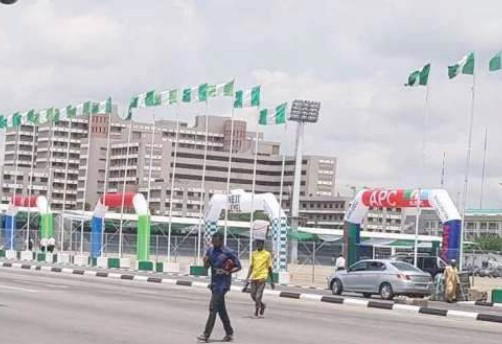
The controversy over Eagle Square goes beyond venue politics, it raises a deeper question about belonging, public trust, and the meaning of democracy in Nigeria.
A democracy is not tested only by how it counts ballots. It is tested by how it treats belonging.
That is why the argument over Eagle Square is far bigger than venue politics. What is at stake is not merely access to a public ground in Abuja, but the moral meaning of public space in the Nigerian republic. Eagle Square is not an APC square.
It is not a PDP square. It is not the ceremonial backyard of incumbency, nor the inherited property of whichever political machine temporarily occupies power.
It is Nigeria’s square. That distinction is not semantic. It is constitutional in spirit and democratic in consequence. Public institutions are the physical language through which a nation expresses belonging. A square such as Eagle Square is more than land and structure. It is civic memory. It is where the republic becomes visible to itself.
Built in 1999 at the dawn of the Fourth Republic, its origin already speaks to its purpose. National, not partisan. Shared, not owned. Public, not appropriated.
Its history makes this difficult to dispute. In 2011, Eagle Square hosted the presidential inauguration of Goodluck Jonathan and Vice President Namadi Sambo under a PDP administration. Across different moments in the Fourth Republic, it has also hosted conventions, rallies, national ceremonies, and civic gatherings that cut across political lines. It has never been permanently assigned because it was never meant to be permanently owned.
That fact alone should settle the argument. The square belongs to the republic before it belongs to the government of the day.
This is the principle every democracy must protect if it intends to remain morally intact. Governments are temporary. Parties are transient. Power rotates through elections and recedes with time. But public institutions endure because they are held in trust for all citizens, including those who do not belong to the ruling coalition of the moment.
The danger begins the moment a ruling party starts to treat national civic space as political inheritance. At that point, something subtle but significant shifts. The republic begins to shrink in perception. Citizens who should feel ownership begin to experience public space as conditional access.
That is how democratic erosion begins—not with rupture, but with normalization.
Eagle Square has never been only ceremonial ground. It has hosted independence celebrations, military parades, remembrance services, labour rallies, religious gatherings, concerts, and mass civic protests. During Occupy Nigeria in 2012, it became not a stage for authority, but a stage for accountability.
That moment alone defines its democratic character. A space that can host both state celebration and public dissent cannot belong to the state alone. It belongs to the people.
The deeper risk is not present usage, but future precedent. Democracies are not only shaped by laws; they are shaped by repetition. When public spaces begin to take on partisan identity by habit, citizens slowly begin to forget they were ever meant to belong there in the first place.
That forgetfulness is the first quiet stage of institutional decline.
Because Eagle Square is not just architecture. It is a civic signal. It represents the principle that no matter who occupies Aso Rock, the republic remains larger than party, larger than incumbency, and larger than the temporary confidence of power.
That square does not belong to APC. It did not belong to PDP. And it will not belong to those who come after. It belongs to Nigeria. And democracies do not begin with collapse.
They begin the day citizens start to ask for permission to belong in their own republic.