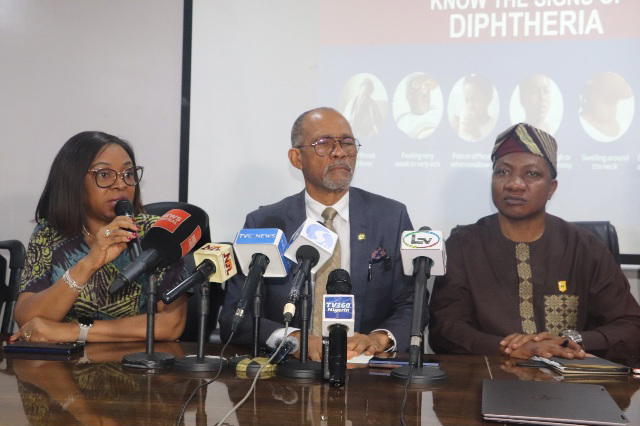
The Lagos state Commissioner for Health, Prof Akin Abayomi on Wednesday raised its disease surveillance and preparedness against diphtheria, warning residents not to panic but to remain vigilant as the outbreak continues to spread in parts of Nigeria
Abayomi, however, said there is currently no outbreak of diphtheria in Lagos, despite recording 53 suspected cases in 2026, six of which were laboratory-confirmed
The Commissioner, who gave the assurance at a media briefing on the state’s diphtheria preparedness and response, said the government was taking precautionary measures because of the high level of movement between Lagos and states currently battling the disease
According to him, the situation requires vigilance because Lagos’ huge population and extensive connections with other parts of the country could facilitate community transmission if imported cases are not detected and managed early
“We are appealing to all Lagosians to remain calm There is no current outbreak of diphtheria in Lagos. We are simply taking precautionary measures,” Abayomi said.
The Commissioner said the government was particularly concerned about the outbreak reported in states including Kano, Katsina, Kaduna, Benue and Zamfara, noting that the continuous movement of people between Lagos and affected areas made surveillance imperative
“We are watching this outbreak expand, and we are cautious in Lagos, as always The Executive Council always likes to err on the side of caution and increase our prevention strategies in the state,” he said.
Abayomi explained that diphtheria is a serious bacterial respiratory infection capable of causing life-threatening complications when treatment is delayed
He said the disease could produce a toxin capable of attacking the heart, while swelling and a thick membrane in the throat could obstruct breathing and swallowing
“There are two major things that happen to a patient with diphtheria First, it can block the breathing apparatus in the throat, preventing the person from breathing normally or swallowing liquids and food properly.
“Secondly, the toxin can enter the blood and travel to the heart, causing problems with the heartbeat and, eventually, heart failure”
He warned that an undiagnosed infection could therefore progress rapidly into airway obstruction and inflammation of the heartAbayomi urged anyone developing severe sore throat, fever, weakness, neck swelling, difficulty breathing or swallowing, particularly after travelling to an affected state or having contact with a confirmed case, to seek medical attention immediately.
“If you have any of these symptoms, present yourself quickly to one of our primary healthcare centres or your doctor so that we can make the diagnosis, carry out the necessary diagnostic workup and start treatment as quickly as possible,” he said
Giving an update on the situation in Lagos, Abayomi disclosed that 53 suspected diphtheria cases had been recorded in the state so far in 2026
Only six, he said, were confirmed through laboratory diagnosis, with all six cases appropriately managed
He added that contacts of confirmed patients were traced and placed under observation throughout the incubation period to detect possible secondary infections
“In Lagos, we have had sporadic cases of diphtheria In fact, in 2026, we have had 53 suspected cases. Of those 53, only six have been confirmed through laboratory diagnosis,” he said.
The Commissioner stressed that early diagnosis significantly improves the chances of successful treatment
“The treatment for diphtheria is very effective if the disease is diagnosed early,” Abayomi said, explaining that treatment involves antibiotics and medication capable of neutralising the toxin produced by the bacteria
While stressing that immunisation remains the most effective protection against diphtheria, Abayomi disclosed that only about 64 per cent of children in Lagos have received full vaccination coverage
He urged parents and guardians to check their children’s immunisation records and ensure that they receive all three doses of the pentavalent vaccine
“If you have received three doses, then you have significant protection If you have received two, one or none, then you are vulnerable,” he warned.
According to him, the three doses are expected to be administered at six, 10 and 14 weeks
He said Lagos has more than 1,000 healthcare facilities providing routine immunisation services across the public and private sectors, with vaccines available free at government facilities
The Commissioner clarified that primary healthcare centres are mainly vaccination points and are not the facilities designated to diagnose and manage suspected diphtheria cases
He listed the four designated centres as the Infectious Disease Hospital, Yaba; Massey Street Children’s Hospital, Lagos Island; Lagos University Teaching Hospital, LUTH; and Lagos State University Teaching Hospital, LASUTH
“If we suspect a case of diphtheria, we refer the patient to designated facilities These are the four centres where we actively manage suspected cases of diphtheria. They have the capacity to make the diagnosis and manage the complications,” Abayomi said.
He noted that severe cases could require advanced intervention to maintain the patient’s airway and close monitoring of the heart to prevent fatal complicationsWith schools expected to reopen soon, Abayomi said the Ministry of Health was working with the education sector to strengthen awareness and vaccination among schoolchildren.
He said suspected cases in schools would trigger contact tracing and other infection-control measures
The Commissioner also urged residents to observe basic respiratory hygiene, including covering the mouth and nose when coughing or sneezing, washing hands regularly and avoiding close contact with others when experiencing respiratory symptoms
Speaking, the Permanent Secretary, Lagos State Ministry of Health, Dr Dayo Lajide, also appealed to parents to ensure their children are fully vaccinated.
“More importantly, we have to make sure that all our children are vaccinated,” Lajide saidShe also urged the media to play a responsible role by providing accurate information to prevent unnecessary panic while encouraging residents to take appropriate preventive measures.
She added that the government’s heightened surveillance was not a declaration of an outbreak in Lagos, but a precautionary response designed to ensure that any suspected case is detected, isolated, investigated and treated before it can trigger wider transmission