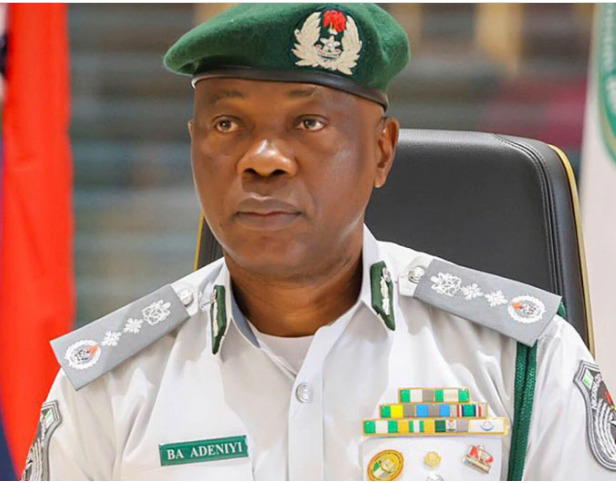
The Nigeria Customs Service has called for a review of import duty concessions valued at N168 trillion, warning that poorly targeted waivers could undermine government revenue at a time the Federal Government is seeking to strengthen public finances and expand funding for essential services.
The Comptroller-General of Customs, Bashir Adeniyi, said the concessions granted in 2024 needed to be examined to determine whether they were achieving their intended economic objectives or unnecessarily depriving the government of revenue
Adeniyi spoke on Tuesday at the third Distinguished Personality Lecture of the TETFund Centre of Excellence in Security Management, University of Ibadan, Oyo State, where he delivered a lecture titled, “Why Customs Matters: Revenue, Security and Nationhood in a Borderless World”
He said the review should form part of a broader effort to strengthen revenue collection through improved compliance, digitalisation, intelligence-led enforcement and more transparent trade procedures
The Customs chief disclosed that the Service generated N728 trillion in 2025, exceeding its target of N6.58 trillion, while collections reached approximately N4.03 trillion in the first half of 2026 against an annual target of N11.07 trillion.
He said the figures demonstrated the growing importance of Customs to Nigeria’s public finances and the need to close revenue leakages without placing unnecessary burdens on legitimate businesses
Adeniyi said Customs revenue was not merely a federal government resource, explaining that import duties contributed to the Federation Account and were distributed among the three tiers of government
Under the allocation formula he cited, the Federal Government receives 5268 per cent, states 26.72 per cent and local governments 20.60 per cent.
He added that, under the new tax laws, 90 per cent of value-added tax collected on imports was allocated to states and local governments
“When a smuggler evades duty, he does not cheat an abstraction called government He cheats a pupil, a nurse and a farmer,” he said.
Adeniyi traced the Service’s revenue growth from N32 trillion in 2023 to N6.105 trillion in 2024 and N7.28 trillion in 2025, attributing the improvement to stronger compliance, improved valuation, digital systems and enforcement.
He said the Service was determined to meet its 2026 target by reducing revenue leakages rather than obstructing legitimate trade
“We will pursue the target through compliance, data and facilitation, not through harassment at the ports, because a target met by choking trade would be a false victory,” he said
The Customs chief also cited the need to address illicit financial flows and trade misinvoicing, through which importers and exporters manipulate the declared value or description of goods to evade taxes, duties and other financial obligations
He said such practices weakened the country’s revenue base and undermined the integrity of its trade system
Adeniyi noted that Africa’s tax-to-GDP ratio stood at about 161 per cent, compared with approximately 33.9 per cent for countries in the Organisation for Economic Co-operation and Development, highlighting the continent’s broader challenge of mobilising domestic revenue.
He said Customs had a critical role to play in closing the gap by improving the accuracy of declarations, strengthening risk assessment and ensuring that eligible transactions were properly assessed
Adeniyi said the Service was deploying digital platforms and data analytics to improve the assessment of imports, detect suspicious declarations and reduce delays at the ports
He disclosed that the B’Odogwu cargo-processing platform handled approximately 16,000 entries and generated N120 billion in revenue in its first three months at the Port and Terminal Multi-Services Limited Command
He said the National Single Window, which went live on March 27, 2026, was intended to connect trade-related government processes and reduce duplication in documentation
“A study conducted at Tin Can Island Port showed that cargo release took almost five days on average, with more than 90 per cent of the time spent waiting“
The Service, he said, was working towards reducing cargo clearance to 24 hours in the long term, with an interim target of two days and a plan to rely on scanning rather than physical examination for 99 per cent of cargo
He added that 51 companies certified under the Authorised Economic Operator programme had reduced their clearance time from 168 hours to 41 hours, while demurrage costs fell by approximately 90 per cent
According to him, the improvements showed that revenue collection and trade facilitation could reinforce each other when procedures were efficient and compliance was properly managed
Adeniyi said revenue protection could not be separated from national security, citing the interception of 399 pump-action rifles and hundreds of firearm components concealed in a container discharged from the vessel MV Velika at Tin Can Island Port in July 2026
The weapons were handed over to the National Centre for the Control of Small Arms and Light Weapons, while the case remained before the Federal High Court
He also recalled the seizure of 844 rifles and 112,500 rounds of ammunition at Onne, Rivers State, in June 2024, as well as the handover of 1,599 firearms seized between 2018 and 2024 to the national centre in February 2025
The Customs chief said the Service had also intercepted 25 containers of fake and unregistered medicines worth approximately N92 billion in July 2025.
On wildlife trafficking, he cited the seizure of 376 tonnes of pangolin scales in Lagos in April 2025, representing at least 1,900 animals, and said enforcement operations since 2021 had led to seizures of more than 25 tonnes of pangolin scales and over one tonne of ivory, with 12 convictions secured.
He also highlighted fuel smuggling, drug trafficking and the illegal movement of food commodities as activities that threatened public safety, economic stability and government revenue
On border management, Adeniyi argued that intelligence-led enforcement and cooperation with neighbouring countries were more sustainable than blanket border closures
He said Nigeria’s land-border closure between August 2019 and December 2020 curtailed some smuggling activities but did not eliminate the networks behind the illegal trade
“The lesson is that a nation is protected by intelligent control of its border, not by sealing it Closure is a blunt instrument, while intelligence, data and joint patrols with our neighbours are sharper ones,” he said.
He called for closer cooperation with border communities and neighbouring countries, while urging traders to use legitimate channels under regional trade arrangements such as the ECOWAS Trade Liberalisation Scheme
Adeniyi also said Nigeria’s participation in the African Continental Free Trade Area depended on effective customs administration to verify the origin of goods and ensure that preferential trade arrangements were properly implemented
Imports from other African countries accounted for approximately four per cent of Nigeria’s total imports in 2025, he said, suggesting significant room for expanding intra-African trade
The Comptroller-General proposed a structured partnership with the University of Ibadan’s Centre of Excellence in Security Management to improve research on border economies, trade compliance and illicit financial flows
His proposals included a Border Economies Research Partnership focusing on locations such as Idiroko, Seme, Jibia and Illela; Customs Data and Analytics Fellowships; and an Illicit Trade Observatory to track trafficking in firearms, drugs, counterfeit medicines, wildlife products and fuel
He also called for independent academic evaluations of the Customs Act 2023, import duty waivers, the Authorised Economic Operator programme and the National Single Window
“A reform that is never evaluated cannot be improved, and I would sooner hear hard truths from Ibadan than discover them too late in the field,” he said
Adeniyi said Customs remained central to protecting Nigeria’s revenue, securing its borders and facilitating legitimate trade
“The world is not borderless It is connected, and that connection makes the border more important, not less,” he said.
Earlier, the Director of the TETFund Centre of Excellence in Security Management, Professor Benjamin Aluko, said the Centre was ready to support Customs through research, professional education and interdisciplinary collaboration
He disclosed that the Centre’s master’s programme in Security Management began in the 2024/2025 academic session with approximately 40 students, largely from security agencies, including Customs Its doctoral programme is expected to admit its first cohort in the next academic session.
The director said the Centre was developing a curriculum for senior Customs officers with support from the Institute for Peace and Strategic Studies and specialists in economics, accounting, sociology, business administration, psychology and other disciplines
He appealed to Adeniyi to provide a 30-seater bus for student field trips and support the establishment of a research and training facility proposed to be named the Bashir Adewale Adeniyi Research and Training Hub
“Our mandate is to strengthen security management through research, professional training and the development of effective early-warning systems”
“We believe that collaboration between academia and security agencies is essential to developing practical solutions to Nigeria’s security challenges”
“The proposed Customs training curriculum will equip senior officers with multidisciplinary knowledge to address emerging security threats”
“Our master’s programme has commenced, and we look forward to launching the PhD programme in the next academic session”
“We appeal for support to acquire a 30-seater Coaster bus to facilitate students’ field research and practical learning”
“A dedicated research and training hub will strengthen our capacity to conduct research and provide specialised training for security professionals,” he said
The Executive Secretary of TETFund, Sonny Echono, was represented at the event by the Director of Research and Development/Centres of Excellence Development, Suleiman Zangina