Nigeria’s ambition to industrialize has long been constrained by a persistent decline in engineering and technical capacity, a challenge that has increasingly drawn concern from policymakers, academics and industry stakeholders. Available data paints a troubling picture.
A 2023 skills-competency survey cited by the Nigerian Content Development and Monitoring Board revealed that more than 70 per cent of engineering graduates in the country lack the hands-on technical skills required by modern industry, while only about five per cent are considered industry-ready at the point of graduation.
This skills deficit is not merely anecdotal; it is rooted in systemic weaknesses in Nigeria’s education-to-industry pipeline. Research findings published in the World Journal of Advanced Engineering Technology and Sciences highlight that young engineering graduates often lack “technical, problem-solving, research and development” skills, with employers expressing concerns over job-readiness and practical competence.
Globally benchmarked assessments reinforce the same concerns. The 2019 Global Engineering Capability Review placed Nigeria in lower tiers across key indicators such as engineering workforce strength, infrastructure, and safety standards, underscoring the country’s struggle to translate academic knowledge into productive engineering output.
Beyond engineering alone, broader labour-market evidence reflects a deeper structural challenge. A 2025 National Skills-gap Study by the Federal Government found that 85 per cent of graduates lack basic digital competencies, while manufacturing employment declined by 21 per cent as hundreds of firms shut down partly due to operational and skills-related challenges.
For a country where over 60 per cent of the population are under 35 years of age, the disconnect between education and employability presents both a risk and an opportunity. As noted in a Daily Trust report, youth potential in Nigeria has been undermined for decades by “unemployment, underemployment and an education–industry gap” that limits the translation of talent into productivity.
It is within this context that the National Agency for Science and Engineering Infrastructure (NASENI) has assumed renewed strategic importance. Established in 1992 by the Federal Government, NASENI is designed as a specialised institution to drive the development of engineering infrastructure, promote indigenous technology, and bridge the gap between research and industrial production.
Over the years, the Agency has evolved into a network of research and Development Institutes spread across the country, each focused on critical sectors such as electronics, materials engineering, manufacturing and power systems, Agricultural mechanization, hydraulics engineering, electronics and advanced manufacturing technology, prototype engineering, etc.
Under its current leadership, NASENI has increasingly positioned itself as a catalyst for reversing Nigeria’s engineering decline through a combination of applied research, skills development and technology transfer. NASENI’s Executive Vice Chairman and Chief Executive Officer, Khalil Suleiman Halilu, has emphasised the centrality of engineering capacity to national development.
“Nigeria’s future lies in our ability to harness and develop the nation’s technological capabilities,” Halilu said, noting that the Agency is “at the forefront of this mission, turning challenges into opportunities for growth and innovation.” This vision is reflected in the Agency’s growing portfolio of research centres and production facilities, which are designed not just as academic institutions but as engines of industrial application.
Across its Development Institutes and Centre of Excellence (CoE), the Agency focuses on converting research outputs into commercially viable products—ranging from renewable energy solutions to agricultural machinery and digital technologies. A defining feature of NASENI’s approach is its emphasis on applied, problem-solving research.
Rather than confining innovation to laboratories, the Agency seeks to ensure that scientific and engineering solutions are directly relevant to Nigeria’s economic needs. This has been evident in interventions such as the local development of disinfectant tunnels and ventilators during the COVID-19 pandemic, demonstrating the country’s latent engineering capacity when properly mobilised.
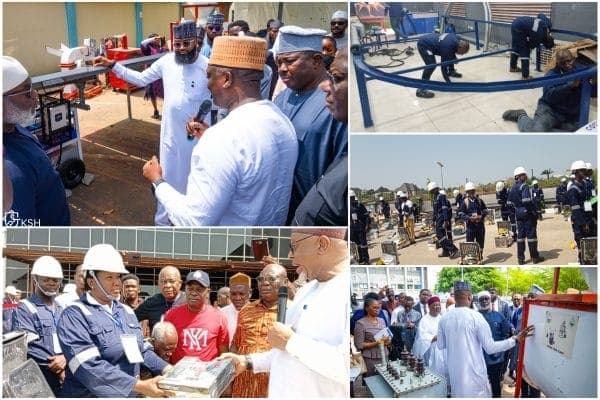
Equally important is NASENI’s investment in human capital development. Recognising that infrastructure without skilled personnel cannot drive industrial growth; the Agency has prioritised training programmes aimed at equipping young Nigerians with practical engineering skills.
Across various states, NASENI’s Skill Acquisition Programme initiative focuses on hands-on learning and training of Nigerian youths in areas such as modern technical, vocational, and digital skills to reduce unemployment, foster entrepreneurship, and drive industrialization. The program focuses on sectors like electrical installation and maintenance, modern shoemaking, tailoring, and technology.
The NASENI Skill Acquisition Programme is designed to address precisely the gaps identified in national surveys—particularly the lack of practical, industry-relevant competencies among graduates and semi-skilled workers.
The Agency’s interventions also extend to targeted programmes aimed at specific demographics. Initiatives such as Delta-2 Programme which support skilled enterprises, scientists and engineers in various technological and manufacturing areas as well as DELT-Her initiative for women in engineering and technology, reflecting broader effort to expand participation and inclusivity within Nigeria’s technical workforce.
In parallel, NASENI has intensified collaboration with universities and polytechnics, recognising that higher education institutions remain central to engineering education. By partnering with these institutions, the Agency seeks to align academic curricula with industry needs, promote research commercialisation, and provide students with exposure to real-world engineering applications
One clear example of collaboration is NASENI’s partnership with the Ahmadu Bello University, where the Agency has worked on research and capacity development initiatives, particularly in engineering design and materials development. The National Engineering Design Development Institute (NEDDI), one of NASENI’s key centres, has maintained linkages with ABU to support research, student training and prototype development.
This relationship allows engineering students to access NASENI’s facilities for practical exposure beyond what is available in conventional university laboratories. NASENI also engaged the University of Nigeria Nsukka (UNN) through its Electronics Development Institute (ELDI) in Awka.
The collaboration focuses on electronics engineering, mechatronics and embedded systems development. Students and researchers benefit from internships, joint research and access to specialised equipment, helping to bridge the gap between theoretical learning and practical application.
In the area of materials science and industrial research, NASENI’s Engineering Materials Development Institute (EMDI) in Akure partners with the Federal University of Technology Akure (FUTA), supporting research into local raw materials development and processing technologies, while also offering students hands-on training in testing, fabrication and product development.
Another notable example is NASENI’s engagement with polytechnics, including the Auchi Polytechnic and the Kaduna Polytechnic, where the Agency has supported technical training, workshops and skills development programmes. These partnerships are particularly important because polytechnics are central to Nigeria’s technical manpower training, yet often lack modern equipment and industry exposure.
Beyond individual institutions, NASENI has also pursued broader system-level collaboration. It is establishing The Sustainable & Emerging Technologies Institute (SETI) as well as Agricultural Incubation Centres in select federal universities across the country – a move aimed at upgrading university research capacity and aligning it with national priorities.
Speaking on the importance of such collaborations, NASENI’s Executive Vice Chairman, Khalil Suleiman Halilu, said the agency is focused on “building strong partnerships with academia to ensure that innovation does not remain in theory but is translated into practical solutions that can drive Nigeria’s industrial growth.”
These partnerships collectively demonstrate how NASENI is embedding itself within Nigeria’s higher education ecosystem—not just as a research body, but as a bridge between classroom learning and industrial application. These collaborations are critical in addressing longstanding concerns about curriculum relevance, ensuring that academic knowledge is complemented by practical experience.
Another key pillar of the Agency’s strategy is technology transfer. By facilitating the movement of innovations from research institutes to small and medium-scale enterprises SMEs), NASENI is working to create an ecosystem where engineering solutions translate into economic value. This approach not only supports industrial growth but also provides opportunities for engineers to apply their skills in productive settings.
The Agency’s broader impact is also evident in its role in promoting indigenous manufacturing. By supporting local production of equipment and technologies, NASENI contributes to reducing dependence on imports, conserving foreign exchange and strengthening national resilience. Countries that have successfully industrialised have done so by investing consistently in engineering education, research and innovation over extended periods.
Nigeria’s renewed focus on these areas, with NASENI at the centre, reflects a recognition that sustainable development depends on technical capacity. Through its research centres, training programmes, academic collaborations and technology transfer initiatives, NASENI is contributing to the gradual rebuilding of the country’s engineering competences and technical foundation.
NASENI’s evolving role offers a glimpse of how that transformation might be achieved—through deliberate investment in people, institutions and ideas, and a sustained commitment to bridging the gap between knowledge and practice.