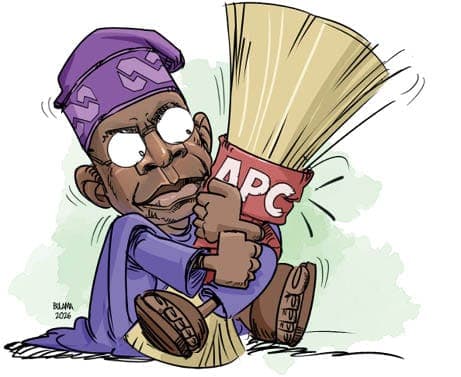
With the commencement of the All Progressives Congress (APC) national convention on Friday, it is becoming glaring that the stage is being set for President Bola Ahmed Tinubu to have a firmer grip on the party ahead the forthcoming primaries.
Party primaries including resolution of disputes arising therefrom, are, going by the schedule of the Independent National Electoral Commission (INEC) supposed to be done between 23rd April and and 30th May 2026.
At the 8th National Convention holding in Abuja with about 8,453 delegates, not much is expected to change in the structure of the party’s National Working Committee (NWC).
While many initially expected the convention to produce an entirely new set of NWC members, the process has been defined by intrigues and permutations since the guidelines were first made public.
Incumbent NWC members reportedly secured the support of the Presidency to remain in office while those eyeing the positions from the outside have raised a series of complaints.
A source revealed that NWC members were given last-minute clearance to remain in office to oversee the party’s primary elections ahead of the 2027 general elections.
Furthermore, the party allotted positions to the six geopolitical zones, restricting interested members to positions within their respective states.
Our correspondents learned that this move allowed only a few state governors to exert influence over who emerges from their states.
Prior to the screening exercise on Tuesday, only the National Chairman, Prof. Nentawe Yilwatda, and the National Secretary, Sen. Ajibola Basiru, appeared certain of their positions. However, other NWC members received a reprieve after the screening when they discovered they were running unopposed.
These include Alhaji Bukar Dalori (Deputy National Chairman), Chief Mathew Uguru (National Treasurer), Chidi Duru (Deputy National Organizing Secretary) and Barr. Felix Morka (National Publicity Secretary).
With this development, unlike previous conventions where certain changes in the leadership structure of the party’s National Working Committee were done, the APC, today, is expected to only ratify the current members of the NWC.
The NWC is largely the administrative arm of the National Executive Committee (NEC) and is responsible for the day-to-day running of the affairs of the party at the national headquarters.
The body is highly relevant during primaries as it screens aspirants vying for elective positions.
Even as many have raised concerns over the tilt of the structure of the party to favour the status quo, the party has explained that it had reasons for that.
Chairman of the APC Convention Central Working Committee and former Katsina State Governor, Hon. Aminu Bello Masari, explained that the party considered composition of the country and the need to respect the federal character in taking the decision on zoning.
Masari, a former governor of Katsina State, said the decision is to ensure that all the regions are included in the party’s NWC, stressing that the NWC structure is strictly based on zoning to maintain order.
Also, ahead of today’s big event, all the state and zonal congresses adopted Tinubu as the sole presidential candidate of the party ahead the primaries.
Sensitive positions like the National Chairman, National Secretary, National Organising Secretary, Legal Adviser and others which usually attract high interest are expected to be endorsed at the convention.
There are observations that most of the key positions are manned by people who attained the office after the inauguration of the current administration.
The national chairman, Prof Nentawe Yiltwada, came into office after the exit of Abdullahi Ganduje, in what is largely believed to be due to the influence of the presidency.
Senator Abubakar Kyari (Borno State) was the Deputy National Chairman (North). He was later appointed the Minister of Agriculture by President Tinubu.
Festus Fuanter (Plateau) was the Deputy National Secretary. He was removed following the emergence of Nentawe as national chairman because two of them are from the same state.
Salihu Lukman (National Vice Chairman, North-West) resigned and withdrew his membership of the party.
Some have interpreted this development as an indication that the party is not functioning independently.
Under the Tinubu administration, the party has had three national chairmen within a spate of less than three years as the current leadership met Senator Abdullahi Adamu as national chairman having transited from the Buhari administration, but he fell out of favour and was replaced by Ganduje under an arrangement that disregarded the zoning structure within the party. Ganduje was later made to leave in hazy circumstances and was replaced with Nentawe.
The national secretary; Surajudeen Ajibola Basiru also replaced Senator Iyiola Omisore, who had been holding the position since the Buhari era.
No deal for new governors
Within two and a half years, no less than eight governors and a high number of federal legislators defected to the party boosting its image. With the latest defection of the governor of Zamfara State, the number of APC governors has now risen to 31.
However, unlike before where the governors of the respective states where party positions are zoned to had the last say on who occupied the seat, under the current arrangement where all the NWC members are being returned, the new governors, it is said, have no influence whatsoever at the national secretariat of the party.
Some of the governors, our correspondents gathered, attempted to lobby for their trusted allies to replace those occupying the seats zoned to their states, but have not been successful.
Delta State governor, Sheriff Oborevwori, had been reported to be interested in having his own man as the national publicity secretary, but at the time of filing this report, it was gathered that he had not been successful.
The governors who defected to the APC, after the inauguration of the current administration, are according to sources not happy with the arrangement as it does not favour any of them.
Checks by our correspondents reveal that if the current structure is maintained as agreed, none of them would have their ally in the national leadership of the party.
These include Oborevwori of Delta; Caleb Mutfwang of Plateau; Agbu Kefas of Taraba; Dauda Lawal of Zamfara; Douye Diri of Bayelsa, Siminalayi Fubara of Rivers; Ahmadu Fintiri of Adamawa and Umoh Eno of Akwa Ibom.
With this, the entire structure according to analysts, would owe its loyalty entirely to the president while the older APC governors could only exert minimal influence.
Controversy over the sale of forms
Allegations surfaced during the sale of nomination forms that the party printed only one form for each position to ensure the return of incumbent NWC members. It was further gathered that when certain governors protested, the party was forced to print additional forms.
However, several intending aspirants who paid for their nomination forms were reportedly never issued the documents.
Conversely, excluded aspirants are “licking their wounds” amid uncertainty regarding their future in the ruling party.
Fubara Dagogo, an aspirant, who sought to run for National Vice Chairman (South-South), has dragged the party to the Federal High Court. He is seeking to halt the convention just as he is demanding N100 million in damages for his exclusion.
Another aspirant, Dr. Oyiborume Paul Yovee, is also considering legal action. Originally eyeing the National Secretary position, Yovee pivoted to National Publicity Secretary (NPS) after the party micro-zoned the former to incumbents. He, too, alleges he was sidelined.
Party clarifies zoning arrangement
The Chairman of the APC Convention Central Working Committee and former Katsina State Governor, Bello Masari, defended the process.
Reacting to the allegations of aspirants being denied forms, Masari stated: “APC is a responsible party. In line with the federal character principle, all offices are zoned. If you come to buy a form, you must buy only for the position set aside for your zone. When an office is zoned to ‘A’ and you are from ‘Z’ but want to buy a form for ‘A,’ we suspect you are only there to create confusion.”
He emphasised that the NWC structure is strictly based on these zones to maintain party order.
Before the current administration
In the past, governors decided who represented their states at the NWC. Former governors of Plateau, Kaduna, Osun, Borno, and many others had their choices upheld in the committee.
Former INEC commissioner, Festus okoye, said the influence of presidents and governors on their parties did not start with the current administration. He said since the return to civilian democratic rule in 1999, various presidents and governors have overseen the rise and fall of party leaders.
“They have orchestrated the ascents and descents of Senate Presidents, Speakers of the National and State Assemblies, and chairpersons of their parties at both federal and regional levels. This influence affects all political parties.
“In some cases, party executives aim to stay in power indefinitely. In certain instances, any exertion of power by party executives leads to their removal. The parties are funded by public money, and their members are not involved in their management. Instead, the Executive provides funding to the parties, which then gives their members a stipend to attend rallies,” he stated.
A party member who does not want to be named said the ratification of the executive today, would accord the president an untrammeled control of the party while governors can no longer use the platform to exert pressure on the presidency.
“You can see that even from the beginning when Abdullahi Adamu was replaced with Ganduje, who is from a different region, no one could challenge it. That means that the trend would continue,” he said.
In the Second Republic
Our correspondents recall that in the Second Republic, the then president did not totally take over the party. Adisa Akinloye, who became the National Chairman of the National Party of Nigeria (NPN) in 1978, preceded President Shehu Shagari, but no attempt was made to replace him as he held the position throughout their tenure until December 1983, when the military sacked that administration.
However, since the current dispensation, most people at the helm of affairs at both state and national levels take over party structures by imposing their loyalists as leaders.
Chief Solomon Lar, who was the pioneer national chairman of the People’s Democratic Party (PDP) who had been in the saddle before Olusegun Obasanjo became president was not allowed to complete his tenure as he was removed from office less then two years after the latter assumed office.
Late president Muhammadu Buhari seemed to toe the line of the Second Republic as he maintained the party structure he met on ground by allowing Chief John Odigie-Oyegun to complete his tenure.