By Emma Ujah, Abuja Bureau Chief
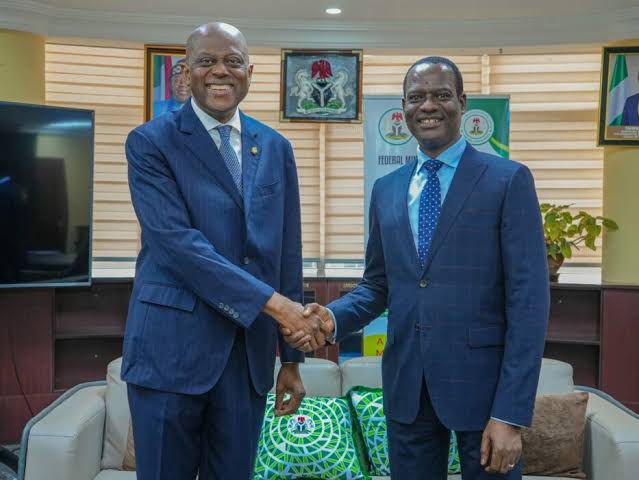
The Central Bank of Nigeria (CBN) and the Federal Ministry of Finance have signed a Memorandum of Understanding (MOU) on Monetary-Fiscal Policy Coordination to strengthen their partnership in the pursuit of stronger macroeconomic management, lasting economic stability and sustainable prosperity for all Nigerians
The Governor of the CBN, Mr Olayemi Cardoso, signed on behalf of his bank, while the Minister of Finance and Coordinating Minister of the Economy, Mr Taiwo Oyedele, signed on behalf of his ministry
Speaking at the event at the CBN headquarters, in Abuja, yesterday, Mr Cardoso said the deal represented a shared commitment to deepen collaboration between the two parties in the interest of the nation’s economy and the Nigerian public
His words, “Fiscal and monetary policies remain two important and complementary instruments for the management of a modern economy While fiscal policy influences economic activity through government expenditure, taxation and borrowing decisions, monetary policy promotes price stability and financial system soundness through the management of liquidity, interest rates and monetary conditions. When these policies work in harmony, their combined impact is far greater than their individual efforts.”
The CBN boss emphasised that the MOU did not mean the creation of a new relationship between the two institutions, as, according to him, the bank and the ministry have worked together for decades in addressing critical macroeconomic issues, including inflation management, debt sustainability, budget financing, exchange rate stability, economic reform programmes and responses to domestic and global shocks
The difference the MOU makes
Mr Cardoso said that although both authorities have been working together, the MOU was necessary, as it provides a clear framework for the type of consultation and information sharing between the two parties and that the relationship would no longer be left to mere individual discretions of office holders
He said, “This memorandum provides a structured framework for regular consultation, information exchange and policy coordination It will strengthen collaboration in critical areas such as government cash management, debt issuance planning, liquidity forecasting, macroeconomic analysis and periodic policy consultations, thereby enhancing policy coherence and the effectiveness of economic management.
“It transforms a relationship built on practice into one anchored by clear processes and enduring institutional commitment By establishing predictable mechanisms for engagement, the framework will improve the quality of decision-making, reduce uncertainty and strengthen our capacity to respond effectively to emerging economic challenges.
“The timing of this agreement is particularly noteworthy as the Central Bank of Nigeria advances its transition towards an inflation-targeting framework Across the world, the success of inflation targeting is known to rest not only on the effectiveness of monetary policy but also on the existence of a supportive fiscal environment.
“The Memorandum will also provide the foundation for developing the operational framework that will guide its implementation Through regular dialogue, information sharing and coordinated policy assessments, both institutions will be better positioned to align their actions, minimise policy trade-offs and pursue shared national objectives.
“The ultimate goal is clear: to build a more stable, resilient and productive economy capable of delivering broad-based prosperity for present and future generations of Nigerians”
In his remarks, Mr Oyedele stressed the need for the two authorities to closely work together while maintaining their respective autonomies, as both work in the interests of the same economy
According to him, “Good economic management requires independent institutions, but independence does not mean isolation Fiscal and monetary authorities have distinct mandates, but we serve the same economy.
“Government borrowing affects liquidity and interest rates Monetary policy affects the government’s financing cost. Tariffs and exchange rates affect prices and revenue. Spending affects demand. Our mandates are distinct, but our outcomes are interconnected. That is the philosophy behind this MOU. We are institutionalising coordination.
“We are not starting from scratch like the governor said already We already have the Economic Management Team, the National Economic Council, and legal linkages between the ministry and the bank.
“The CBN Act provides for the bank’s autonomy, while its governance architecture includes representation from the ministry of finance
This MOU makes those linkages more deliberate and effective through stronger informational sharing, aligned macroeconomic assumptions, more consistent forecasts, and clearer mechanisms for resolving areas where fiscal and monetary actions may pull in different directions”