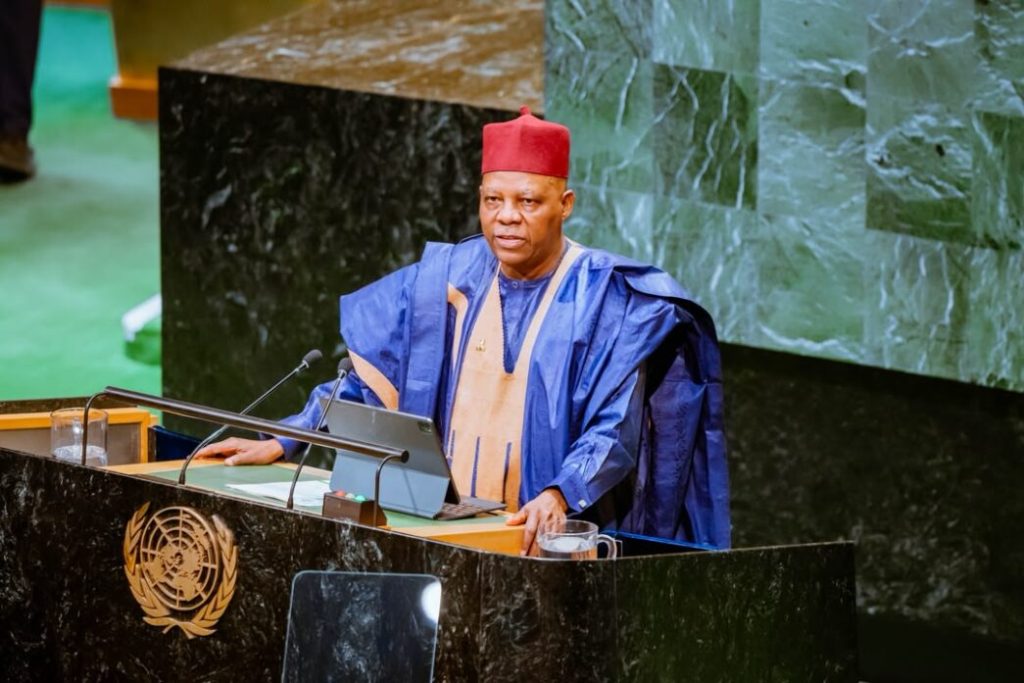
Nigeria has warned that powerful national defences alone cannot protect countries from terrorism, cyber threats and other dangers sustained across international borders
Vice-President Kashim Shettima gave the warning while delivering President Bola Tinubu’s national statement at the UN General Assembly in New York on Thursday
Drawing from Nigeria’s prolonged battle against Boko Haram, ISWAP and other armed groups, Shettima called for stronger international cooperation against transnational security threats
He argued that modern threats exploited gaps between countries and could not be effectively defeated through isolated national responses
Nigeria’s experience, he said, demonstrated that security challenges sustained across borders required corresponding regional and global cooperation
Shettima told the Assembly that military operations remained necessary but could not, by themselves, deliver lasting victory over violent extremism
He said sustainable security must also rest on education, economic opportunity, accountable governance and respect for human rights
The Vice-President linked the argument to Nigeria’s wider advocacy for collective security and effective multilateral institutions
He said Nigeria remained ready to work with neighbours and international partners to confront terrorism and other destabilising threats
Through ECOWAS, the African Union and Gulf of Guinea partnerships, he said Nigeria continued to participate in mediation, counter-terrorism, maritime security and efforts to strengthen democratic governance
Shettima also recalled Nigeria’s long record of contributing personnel and resources to peace operations across Africa
He cited engagements in Liberia, Sierra Leone, Darfur, Mali and The Gambia as examples of Nigeria responding to instability beyond its national borders
The Vice-President said such engagements reflected the country’s conviction that conflicts in one country could generate consequences for neighbours and the wider international community
He warned world leaders against assuming that distant wars carried no costs for countries geographically removed from them
Shettima argued that conflict could disrupt trade, increase humanitarian pressures, drive displacement, strengthen extremist networks and create wider economic and security shocks
He, therefore, called for renewed commitment to dialogue, mutual respect, collective responsibility and international law
Shettima reaffirmed Nigeria’s support for the peaceful resolution of disputes under the UN Charter
He identified Sudan and other conflict-affected countries as requiring urgent diplomatic attention because of the consequences for civilians and regional stability
The Vice-President also warned against rising nationalism and weakening commitment to multilateral cooperation
He said the continuing conflicts around the world recalled the fundamental reason the United Nations was created after the devastation of the Second World War
According to him, Nigeria remains committed to an international order where disputes were addressed through diplomacy rather than arbitrary power
Shettima linked international security to development, maintaining that deprivation and institutional weakness could undermine the durability of military gains
The Nigerian delegation also called for stronger global institutions capable of coordinating responses to terrorism, cyber threats and other challenges that did not respect national borders
The address came as the General Assembly’s 81st General Debate entered its third day, with Shettima speaking fourth during Thursday’s afternoon session
Nigeria said its experiences with insurgency had reinforced its belief that peace required both effective security measures and conditions that denied violent groups opportunities to recruit and operate
Shettima, therefore, urged greater international solidarity, regional leadership and sustained investment in the social foundations of peace (NAN).