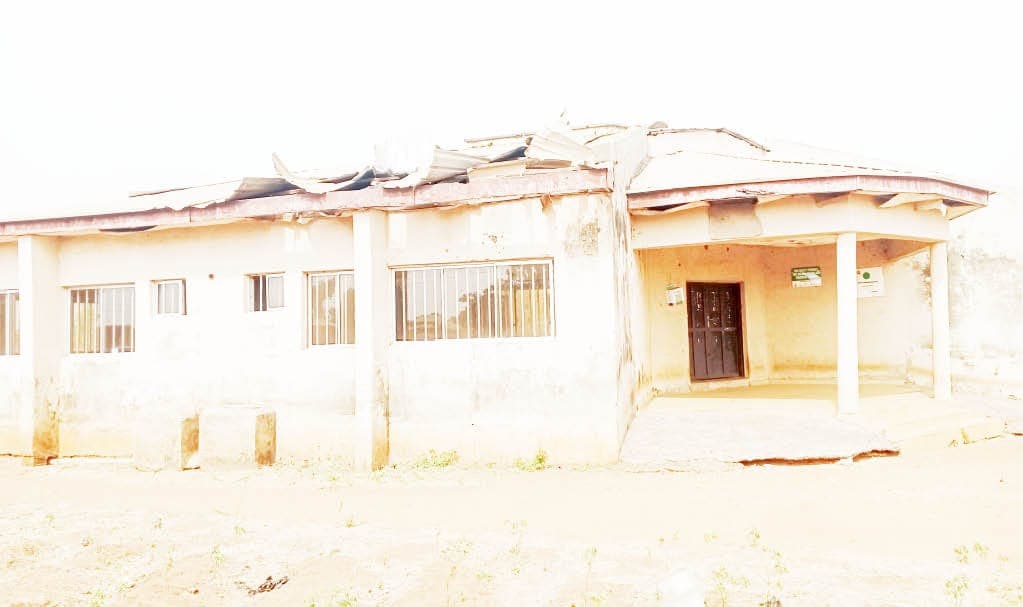
Residents of the Ubosharu community in Wako Ward, Kwali Area Council of the FCT, have expressed deep concern over the dilapidated state of their local health centre.
Community members say their fears have heightened with the onset of the rainy season due to the facility’s severely leaking roof.
Beyond the crumbling infrastructure, residents complained of a chronic lack of medication.
They noted that they are often forced to travel to Abaji or Kwali to purchase drugs or rely on private chemists within the community.
When Abuja Metro visited on Saturday, residents described the health centre—built over 18 years ago—as an “eyesore.”
Ismaila Danjuma, a community member, who led our reporter through the facility, said the condition of the building has made seeking medical treatment a significant challenge, particularly for pregnant women. He noted that even when patients visit, they cannot access medication; instead, the personnel on duty prescribe drugs for patients to buy elsewhere.
“Apart from the dilapidated building, patients have to travel to either Abaji or Kwali whenever drugs are prescribed by the staff manning the facility,” he said.
Another resident, Yakubu Gambo, highlighted the risks faced by expectant mothers. He explained that many women travel to general hospitals in Kwali or Abaji for antenatal care due to the lack of basic equipment at the local centre.
“In fact, when my wife went into labour two weeks ago, I had to take her to Abaji General Hospital on a motorcycle at night. That is where she eventually gave birth,” Gambo said.
He added that the roofs of the health centre, including the male and female wards, are leaking—a condition he attributed to recent windstorms.
A community leader, Joshua Audu Gimba, echoed these concerns.
He expressed disappointment that despite the community’s proximity to the Abuja-Lokoja highway, the government has not rehabilitated the facility.
He noted that accident victims are sometimes brought to the centre, only to be transferred to Abaji because the clinic is unequipped to handle them.
“As you can see, the health centre is located just a few meters from the Abuja-Lokoja highway. One would expect the government to intervene by fixing and upgrading the facility,” Gimba said.
During a tour of the premises, our correspondent observed that portions of the roof had been blown off by windstorms, while the interior ceilings had caved in.
The community leader also lamented the lack of clean water. The growing population of Ubosharu relies on only two hand-pump boreholes. Consequently, women often trek long distances to fetch water from a stream or rely on a tap at a nearby NNPC pumping station.
“The population in Ubosharu has increased because our location near the highway attracts new residents building houses, but there isn’t enough pipe-borne water to sustain the population,” he added, appealing to the council authorities to sink additional boreholes.
An official in the council’s Works Department, who spoke on condition of anonymity, told our reporter that the council had already budgeted for additional boreholes in several rural communities, including Ubosharu.
“The area council has recently been going round rural communities to refurbish grounded boreholes and health centres, including the one in the community you mentioned,” the source said, assuring that arrangements have been concluded to rehabilitate dilapidated health centres throughout the council.