Nigeria has a peculiar way of remembering power We remember the men who speak loudly, the men who appear beside the President at important ceremonies, the men whose names travel through television studios and political meetings until their voices become part of the background noise of government. Women in power are often treated differently. They are noticed when they make an entrance, photographed when they are appointed, briefly discussed as evidence that government has not forgotten the existence of women, and then returned to the margins of public attention.
That is one reason the women serving in President Bola Ahmed Tinubu’s government deserve a closer look There are fewer of them than there should be, but the more important question is not simply how many women are in government. It is what kind of power they have been given, what they are doing with it, what they have changed and whether Nigerians are paying enough attention to the decisions being made in rooms where these women now sit.
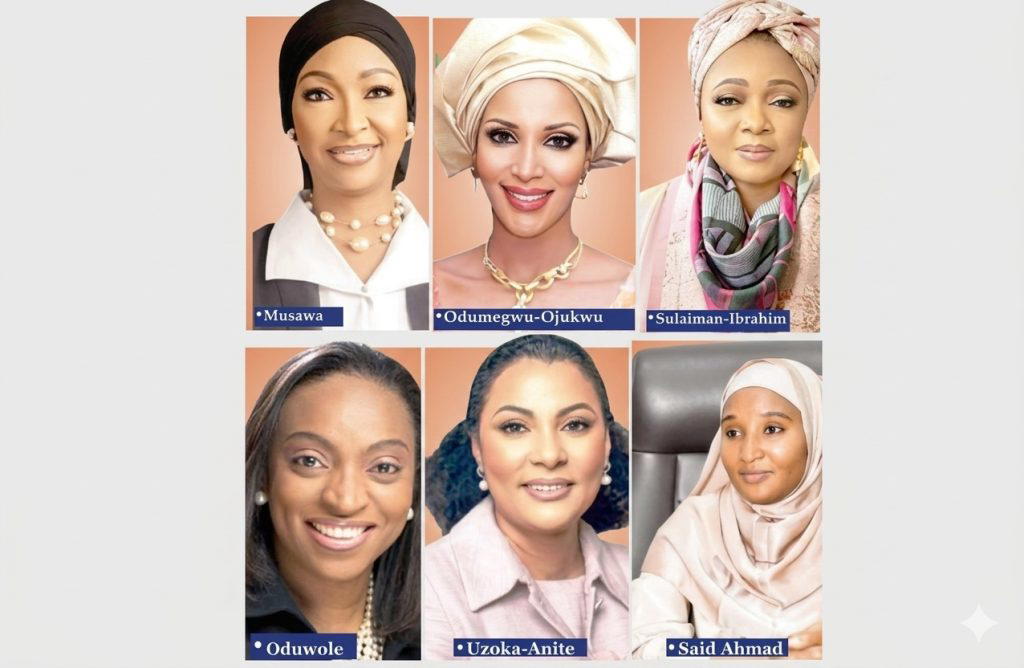
Tinubu’s cabinet includes Hannatu Musa Musawa at the Ministry of Art, Culture, Tourism and the Creative Economy; Bianca Odumegwu-Ojukwu at Foreign Affairs; Imaan Sulaiman-Ibrahim at Women Affairs; Jumoke Oduwole at Industry, Trade and Investment, Doris Uzoka-Anite as Minister of State for Budget and Economic Planning, Suwaiba Said Ahmad as Minister of State for Education, and Nkeiruka Onyejeocha as Minister of State for Labour and Employment
They represent different kinds of experience, and that matters Nigerian politics sometimes talks about women as though gender automatically gives them a common political outlook. It does not. A diplomat does not necessarily understand power in the same way as an academic. A former legislator approaches government differently from a policy specialist. Gender may shape the obstacles people encounter, but it does not erase ambition, ideology, temperament, competence or political judgment.
So the right question is not whether these women deserve praise for being in government It is whether they deserve to be taken seriously as people exercising power.
As Minister of Women Affairs, she heads a ministry that governments have too often reduced to empowerment announcements, commemorative speeches and photographs Yet her background in humanitarian affairs, migration, conflict resolution and development, including her time as Director-General of the National Agency for the Prohibition of Trafficking in Persons, gives her experience relevant to some of the hardest realities facing Nigerian women.
The test should therefore be bigger than another International Women’s Day statement Can her ministry influence policy beyond its own walls? Can it strengthen the institutions responsible for protecting women? Can it reach women dealing with poverty, trafficking, displacement and violence? Most importantly, can it make the rest of government treat women’s issues as matters of national policy rather than the responsibility of one ministry?
That is what meaningful power looks like Not visibility, but the ability to make something happen.
She sits in a different part of the machinery, and arguably one of the most consequential As Minister of Industry, Trade and Investment, she is close to the decisions that determine whether Nigerian businesses can produce, invest, export and survive.
Nigeria does not suffer from a shortage of policies It suffers from the distance between policy and reality. A business owner can hear government promise to support enterprise and then spend days dealing with overlapping agencies, licensing requirements, taxes, unreliable electricity and transport costs.
Oduwole’s ministry has already been involved in substantial trade reforms In January 2026, Nigeria and the United Arab Emirates signed a Comprehensive Economic Partnership Agreement after negotiations led by her ministry.
The agreement provides new market access for Nigerian goods and services, including the elimination of UAE tariffs on more than 7,000 Nigerian products Her ministry has also been given a leading role in implementing the National Single Window, designed to reduce duplication and streamline import and export procedures.
Those are significant developments But they also create a higher standard of accountability. A trade agreement matters only if Nigerian businesses can actually use it. A single-window platform matters only if it reduces the delays, costs and bureaucratic obstacles traders have complained about for years.
That is where Oduwole’s real test lies Whether reform moves from government documents into the daily experience of Nigerian businesses.
She sits close to another critical pressure point As Minister of State for Budget and Economic Planning, she is part of the machinery that turns government priorities into actual spending.
A budget is where political promises meet arithmetic There is only so much money available, and every naira spent on one priority is unavailable for another. After asking Nigerians to endure painful economic adjustment, the administration cannot escape the question of what those sacrifices are producing.Where is the investment that expands productive capacity? Where are the public services that make reform credible? Where is the infrastructure that allows businesses to become more productive rather than simply more expensive to operate?
Those questions are bigger than one minister, but people inside the budget machinery cannot be insulated from them
Her portfolio presents another test Nigeria has already demonstrated that it can produce culture the world wants. Afrobeats, Nollywood, fashion, publishing and the wider creative industries have given the country enormous global influence. What Nigeria has not always done well is build the institutions needed to capture the full economic value of that creativity.
The creative economy cannot become another government slogan Artists and entrepreneurs need intellectual-property protection, finance, infrastructure and functioning institutions. Musawa’s challenge is to help turn cultural influence into sustainable economic opportunity rather than simply celebrate an industry that has already proved its worth.
She brings a different kind of authority A lawyer, diplomat and former ambassador, she moved from Minister of State for Foreign Affairs into the substantive Foreign Affairs portfolio.
Foreign policy is often misunderstood because much of its most important work happens away from cameras It is negotiation, regional strategy and the patient protection of national interests. It is also inseparable from Nigeria’s economic ambitions.
The question is not how many international meetings Nigeria attends It is what Nigeria gains from them. Does diplomacy help Nigerian businesses? Does Nigeria have greater strategic influence? Are Nigerians abroad receiving effective consular support? Is the country becoming more consequential internationally?
She brings academic expertise into the education ministry, where the crisis is far deeper than examination results Nigeria must ask what children are learning, whether teachers are adequately prepared, whether schools can support modern skills and whether graduates are being prepared for an economy capable of absorbing them.
Her academic background is useful, but credentials are not results The education system does not need another official who can describe its problems eloquently. It needs institutions that actually improve.
Nkeiruka Onyejeocha brings legislative experience to Labour and Employment at a particularly difficult moment Workers are struggling with the cost of living, employers face rising operating costs, and millions of Nigerians remain trapped in informal employment.
Job creation cannot remain a slogan The ministry has to navigate the difficult relationship between wages, productivity, inflation, business survival and employment. Political experience may help Onyejeocha navigate that terrain, but the real measure will be what workers and employers can actually feel.
And this is where the conversation about these women should become more mature
There is nothing inherently progressive about appointing a woman if the institution she leads remains ineffective But there is also nothing intellectually honest about dismissing a woman’s achievements because she serves in a government one does not support.
What did she inherit? What has she changed? What did she promise? What happened afterwards? Did she challenge bad policy when it mattered? Did she strengthen the institution she was appointed to lead, or merely defend the administration that appointed her?
And when she gets something right, Nigerians should be prepared to say so
Political power in Nigeria is too often viewed through a male lens We watch the President, governors, party leaders and the men surrounding them, while paying less attention to the quieter machinery through which government actually works.
But power also sits in ministries, diplomatic missions, regulatory institutions and budget offices It belongs to the people who write policies, allocate resources, negotiate agreements and decide how government interacts with citizens.
Women occupy some of those rooms now Their presence is worth acknowledging. Their performance is worth examining. Their failures are worth exposing. Their achievements are worth recognising.
Representation gets a woman through the door Authority is what she does after the door closes.
That is why the women in Tinubu’s government deserve more than photographs and celebratory headlines They deserve our attention. Not because they are women. Because they have power.