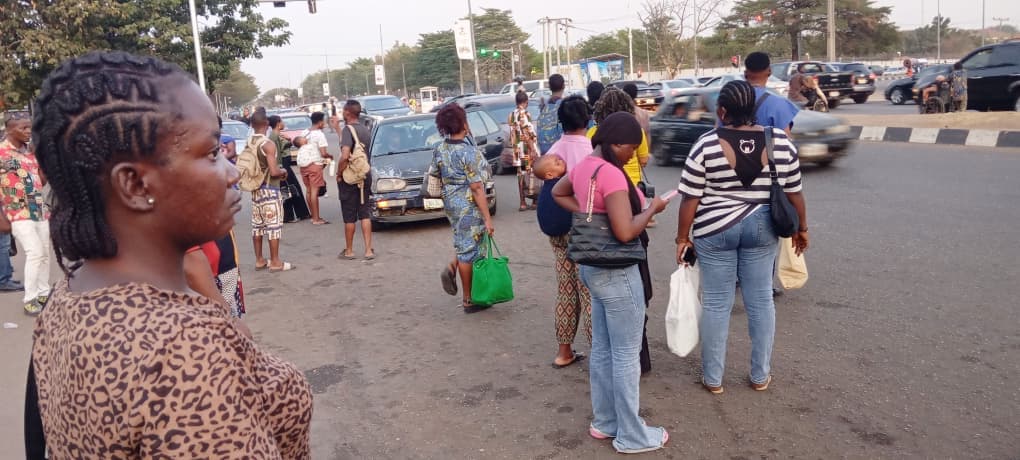
There is a quiet crisis unfolding daily in Abuja, quiet not because it is small, but because those in power have chosen not to hear it. It is the sound of thousands of Nigerians stranded at bus stops before dawn. It is the anger of workers watching half their salaries disappear into transport fares. It is the exhaustion of a city that was planned for order but now runs on chaos. Abuja’s public transport system is not just failing it has collapsed.
For the average resident, especially medium and low-income earners, movement across the city has become a daily punishment. There is no reliable bus system. No coordinated network. No price stability. Just a disorderly mix of minibuses, tricycles, and opportunistic operators dictating fares at will.
In a city where distances are vast, this is not an inconvenience. It is economic violence. A worker living in Nyanya or Kubwa can spend up to a third of their income just trying to get to work. A petty trader from Karu may lose hours each day in transit, with no guarantee of safety or predictability. The result is a silent erosion of livelihoods one bus fare at a time.
And yet, this disaster was never supposed to happen.
From the beginning, Abuja was built on a clear and ambitious master plan. It envisioned a modern capital with a hybrid transport system integrating rail, buses, and road networks into a seamless whole. That vision has not failed. It has simply been abandoned. What we are witnessing today is not a planning failure. It is a governance failure.
Even more disturbing is the glaring double standard.
While Abuja struggles in neglect, Lagos has received massive federal backing for its urban transport revolution. Billions of naira have gone into rail projects and structured mobility systems designed to ease congestion and improve daily life. No one begrudges Lagos that investment. It is necessary. But Abuja is the capital of the Federal Republic. So why is the seat of power left to rot while resources are deployed elsewhere? Why is the city that houses the presidency itself subjected to such dysfunction? And most importantly why has there been no urgency from the very top?
President Bola Ahmed Tinubu lives and works in Abuja. He sees the traffic. He hears the complaints. His aides navigate the same broken system albeit shielded by convoys and privilege. This is not a hidden problem. It is a visible failure. And silence in the face of such failure is no longer acceptable.
As the 2027 Nigerian general elections draw closer, Abuja’s transport crisis must become a defining political issue. Enough of abstract debates. Enough of distant macroeconomic promises. This is about whether Nigerians can move.
Because when a government cannot guarantee mobility in its own capital, it raises serious questions about its priorities and its competence. Transport is not cosmetic infrastructure. It is the engine of productivity. When it fails, everything else suffers. Businesses slow down. Workers arrive late or not at all. Opportunities shrink. Inequality deepens. What is happening in Abuja is not just inefficiency. It is systemic neglect. The solution is neither mysterious nor unattainable. The federal government must immediately revive and implement the Abuja master plan’s transport provisions. Not in fragments, not in pilot schemes but as a coordinated system. Mass transit buses must be deployed at scale, regulated, and made affordable.
The rail system must be expanded beyond tokenism and integrated into daily commuting reality. Private operators must be brought under strict oversight not allowed to exploit desperation. Most importantly, this requires political will the same will that has driven high-profile projects elsewhere.
Abuja does not need new ideas. It needs leadership. If billions can be mobilized for rail in Lagos, then the capital city deserves no less. Anything short of that is a clear statement that the daily suffering of Abuja’s residents does not matter.
And that is a dangerous message to send at a time when public trust is already fragile. The truth is simple: a capital city that cannot move its people is a capital in decline. This is no longer just about transport. It is about fairness. It is about governance. It is about whether those in power are willing to confront problems that affect ordinary Nigerians or continue to look away. Abuja is breaking down in plain sight. The question is whether the president will act or wait until the voters respond.
Toro lives in Zone 7, Abuja